

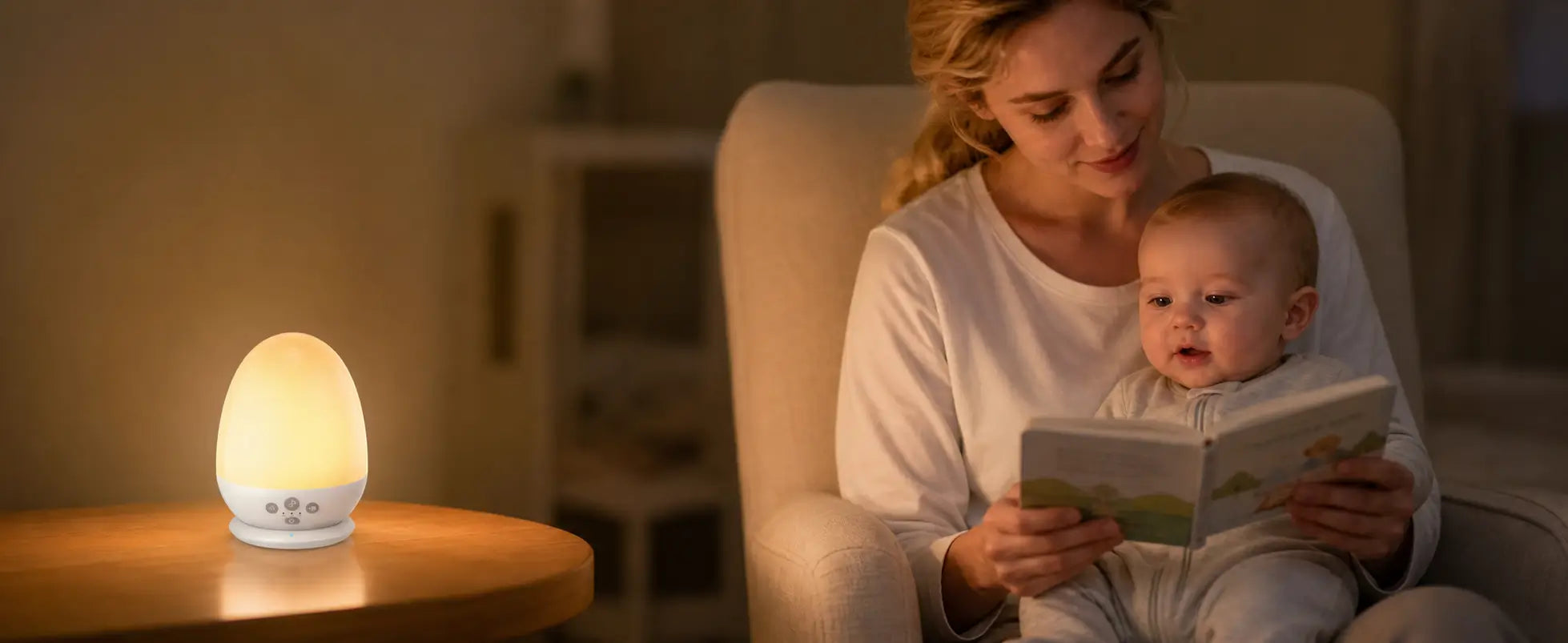
At the end of the day, bedtime can still include small interruptions: a door closing down the hall, a pet moving nearby, or conversation from another room. After a feed and diaper change, those sounds can feel more noticeable just as you are trying to settle your baby.
Some families use white noise as a steady background sound for the final part of bedtime. Once the device is set to a low volume and timer, the same sound can stay on while you finish settling your baby.
This guide shows where white noise can fit into a bedtime routine, how to set up placement, volume, and a timer, and what to adjust if the setup is not working for your family.

How Can White Noise Fit Into a Baby’s Bedtime Routine?
White noise creates a steady background sound that can make abrupt household noises, such as a closing door, less noticeable at bedtime. For some babies, that may make settling easier. In a bedtime routine, turn it on after active care and before you settle your baby in a clear, separate sleep space.
A small 1990 randomized trial gives one early example. Among 40 newborns, 16 of the 20 babies exposed to white noise fell asleep within five minutes, compared with 5 of 20 in the control group. The study looked at short-term settling in newborns. It does not show that white noise makes sleep longer or prevents every waking.
Consistency matters too. A baby sleep schedule can provide a wider view of how a familiar bedtime routine fits into the first year. In a study of 320 healthy 6-month-old infants, more frequent bedtime routines were associated with less variable nighttime sleep. White noise was not tested on its own, but the finding supports a useful approach: keep the order familiar. Feed, change, share a quiet moment, turn on the sound, then lay your baby down.

How Can You Add White Noise to a Baby’s Bedtime Routine?
Keep the order short enough to repeat on an ordinary evening. White noise usually comes near the end, after feeding, a diaper change, and any comfort your baby needs. It creates a steady background for the last part of the routine. It does not replace care when your baby needs attention.
Then lower the stimulation. You might share a short book, sing one song, or sit for a quiet cuddle. MedlinePlus recommends a regular, pleasant bedtime routine and low-key nighttime care. The exact activity matters less than using a familiar order that another caregiver can follow.
Keep the light low while you finish care. A dim baby night light can give you enough visibility for a feed or diaper change before the room settles down.
Turn on the sound before you lay your baby down. Start low and keep it steady. Research has not established one sound as best for every baby, so there is no need to search for a special frequency. Focus on a sound that stays even without making the room feel loud.
Finish in a safe sleep space. Put your baby on their back on a firm, flat, level surface made for infant sleep, with only a fitted sheet. The NICHD safe-sleep guidance supports keeping the sleep space clear. Keep the sound device outside the crib or bassinet, with its cord out of reach.
If you use light alongside sound, these baby night light dos and don'ts can help you keep the light useful for care without shining it toward the sleep space.
Before bedtime, choose how long the sound will run. A timer can end it after settling and follows the AAP’s direction to limit duration. If you adjust the routine later, change one setting at a time, such as the timer, so you can see what helps.

What Does 50 dBA Mean for Baby White Noise?
Fifty dBA is a useful reference point, but it needs to be considered alongside distance and duration. The number appears often in conversations about baby white noise because it was used as a hospital-nursery reference in earlier sound research.
In a 2014 study of 14 infant sleep machines, researchers measured devices at their maximum setting from 30, 100, and 200 centimeters away. At the closest distance, every device exceeded 50 dBA and three exceeded 85 dBA. The study compared 50 dBA with hospital-nursery guidance and 85 dBA with an adult occupational exposure limit.
For parents, the useful lesson is to avoid treating 50 dBA as a single setting that works in every room. A device’s placement, the setting you choose, and how long it runs all shape the sound reaching your baby.
Place the device well away from the crib, begin at a low volume, and decide its run time before bedtime. Those three choices give you a more useful starting point than trying to match one number.
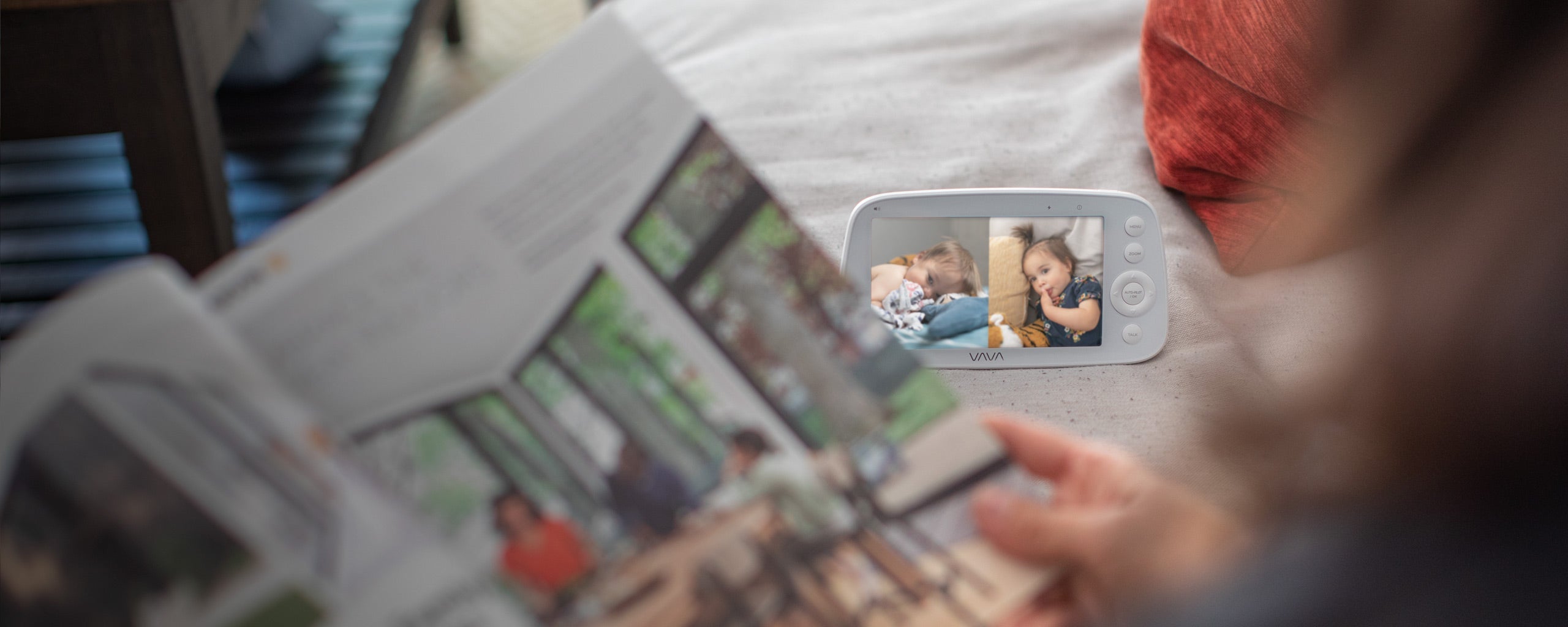
If your baby sleeps in another room, a baby monitor lets you listen and check in separately while white noise stays at a low setting.

What Does Research Say About White Noise for Babies?
Research can help set expectations, but the studies do not all ask the same question. Some look at how newborns settle in the moment. Others look at sleep over time or at the sound a device can produce.
|
Question Parents Ask |
What We Know So Far |
|
Can white noise help at the start of sleep? |
The small newborn study discussed earlier suggests that white noise may help some babies settle in the moment. It does not describe every stage of infant sleep. |
|
Will it improve every night of sleep? |
A 2021 systematic review of 38 studies found mixed results and rated the evidence for improved sleep as very low quality. |
|
What should parents pay attention to while using it? |
A 2024 scoping review supports limiting maximum sound intensity and duration, while further research continues on the best settings for children. |
Taken together, the research gives white noise a clear role in the bedtime routine. It can support the final minutes of settling when a steady background sound suits your home. Placement, volume, and run time deserve as much attention as the sound itself.
Should White Noise Run All Night?
A timer is a better starting point than automatic all-night playback. The AAP advises limiting the duration of infant sleep-machine use, including using a timer or turning the device off after a baby falls asleep. Research has not identified one ideal run time for every baby.
Choose a setting that covers the settling part of your routine. If your baby regularly stirs when the sound ends, try a longer timer on a later night while keeping placement and volume the same. Changing one part at a time makes it easier to tell whether timing, rather than sound level, is affecting the routine.
The VAVA Egg Baby Night Light Plus has 30-, 60-, and 90-minute timer settings, so you can adjust duration without changing the other controls. Keep the device away from your baby and the volume low whichever timer you use.

When Can You Stop Using White Noise for a Baby?
White noise can stay a familiar part of bedtime for as long as it serves your routine. If you decide to use it less often, there is no one age when every baby needs to stop.
If you want to phase it out, change one part of the setup over a few sleep periods:
- Lower the volume while keeping the device in the same place.
- Shorten the timer once the lower setting feels familiar.
- Keep the rest of the routine the same, including the book, song, or cuddle that comes before bed.
- Try one nap or bedtime without the sound before removing it from every sleep.
Keep the rest of bedtime familiar while you make the change. Adjust the volume or timer one at a time, so you can see how that change affects the routine.
What Should You Check if White Noise Is Not Helping?
Start with the parts of bedtime that come before the sound. If your baby does not settle, check whether they still need feeding, a diaper change, comfort, or a calmer transition into sleep. White noise can sit in the background while you respond to those needs.
If bedtime still feels uneven before white noise begins, a baby sleep schedule by age can help you review how naps and bedtime change through the first year.
Then look at the setup itself. If the sound seems to add stimulation instead of softening household noise, lower the volume before making any other change. More volume is rarely the first adjustment worth making.
Consistency also matters when more than one person handles bedtime. Agree on the device location, the starting volume, the timer, and the order of the routine. That gives your baby the same sequence, even when a different caregiver is on duty.
Look at the pattern across several sleep periods instead of judging the setup after one difficult night.
Conclusion
White noise can soften abrupt household sounds during the final minutes of settling. It works best alongside the care and familiar order that already shape your baby’s bedtime. Keep the device away from the crib, begin at a low volume, and choose its run time before you start the routine.
If you want those controls in one place, the VAVA Egg Baby Night Light Plus combines 18 built-in white-noise sounds, adjustable light, and 30-, 60-, and 90-minute timer settings. That gives you room to set the sound and light for bedtime without adding more steps to nighttime care.

FAQs
1. Can I Use White Noise for Naps as Well as Bedtime?
Yes. Daytime naps can come with more household activity, such as siblings playing, chores, or normal conversation. Use the same low, well-placed setup you use at bedtime instead of raising the volume to cover a busier room.
2. Should I Restart White Noise After a Night Feed?
If white noise is part of your bedtime routine, you can return to the same low setting and timer after you finish feeding or changing your baby. A middle-of-the-night waking is not the time to move the device closer or increase the volume.
3. Will White Noise Make the Room Louder?
White noise adds a steady sound, but its purpose is to make sudden household noises less noticeable. Keep it low enough that it softens interruptions without becoming the loudest sound in the room.
4. Can I Use White Noise When We Travel or Sleep in a Different Room?
You can bring the same familiar sound, but set it up again for the new space. Keep the device outside the sleep area, make sure cords stay out of reach, and begin with the same low setting you use at home.
5. How Can Different Caregivers Keep the Setup Consistent?
Leave a short note with the device location, starting volume, timer, and the usual order of bedtime steps. The routine can still flex around feeding and comfort, while the sound setup stays familiar.
Resources
- American Academy of Pediatrics: Preventing Excessive Noise Exposure in Infants, Children, and Adolescents
- NICHD Safe to Sleep: Safe Sleep Environment for Baby
- CPSC: Baby Monitor Cords Have Strangled Children
- White Noise and Sleep Induction
- Infant Sleep Machines and Hazardous Sound Pressure Levels
- Noise as a Sleep Aid: A Systematic Review
- Bedtime Routines and Objectively Assessed Sleep in Infants
- Continuous White Noise Exposure During Sleep and Childhood Development
- MedlinePlus: Sleep and Your Baby
Share: