

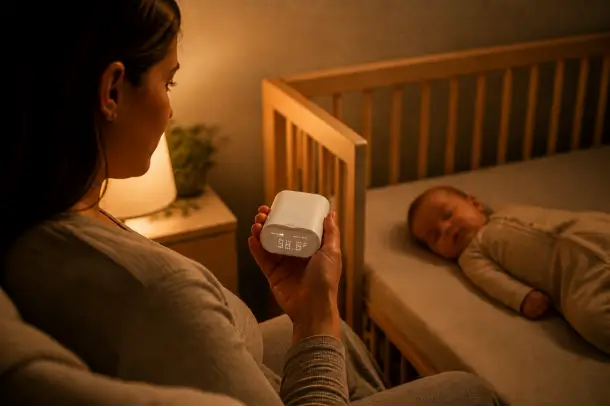
A regular digital thermometer is a practical choice when you need one temperature reading now. A smart wearable thermometer is more helpful when you expect to check repeatedly and want to follow changes without waking your baby each time.
That is the main difference. One gives you a reading for a single moment. The other continues measuring, keeps the current temperature available, and can alert you to a change.
The choice may feel unimportant when both products appear to do the same basic job. It becomes much easier to understand at two in the morning, when your baby has only just fallen asleep and you are wondering when to check again. A regular thermometer answers the question once. A smart wearable thermometer is designed for the hours that follow. This guide compares their accuracy, safety, comfort, and everyday use so you can decide which routine fits your family.

Smart vs Regular Baby Thermometer at a Glance
|
What You Are Comparing |
Regular Digital Thermometer |
Smart Wearable Thermometer |
|---|---|---|
|
How it measures |
Takes one reading per measurement |
Continues measuring while the sensor is worn |
|
What you do for the next check |
Position the thermometer and measure again |
Look at the receiver or connected display |
|
Best for |
Occasional checks |
Fever nights, naps, and longer monitoring periods |
|
Alerts |
Usually beeps when one measurement is complete |
Can provide automatic temperature alerts during monitoring |
|
Effect on rest |
May require waking or repositioning the baby for each check |
Lets the baby continue resting while the sensor stays in place |
|
Where results appear |
On the thermometer |
On a receiver or phone, depending on the model |
|
Main advantage |
Simple and familiar |
Fewer repeated measurements and a clearer view of temperature changes over time |
|
Main limitation |
Every new reading requires another measurement |
The sensor must remain securely placed against clean, dry skin |
Neither type is automatically better for every family. The better choice depends on whether you need one reading or ongoing awareness.
What Happens With a Regular Digital Thermometer?
A regular digital thermometer gives you a fresh reading each time. Depending on the model, you may place it under the arm, in the mouth, or rectally. You hold it in the correct position, wait for the completion signal, read the screen, and clean it afterward.
That routine is straightforward when one measurement answers your question. It also gives you the flexibility to choose a thermometer made for the body site recommended for your child's age.
The inconvenience appears when you need another reading an hour later, and then another after that. Each result requires a separate measurement. If your baby has just settled, even a quick check can mean turning on a light, moving clothing, positioning the thermometer, and helping your baby settle again.

What Makes a Wearable Thermometer Smart?
For this comparison, smart means that the thermometer keeps measuring after the sensor has been attached. Depending on the model, readings may appear on a phone or on a separate receiver. Some models can also alert you when the temperature reaches a set level or when the sensor needs attention.
The benefit is not simply that the display is digital. A regular thermometer has a digital display too. The useful difference is that you can look again without performing another complete measurement. This turns temperature checking from a series of separate events into a continuous view over the period when someone is unwell.
A wearable requires some preparation. The sensor needs to be charged, positioned correctly, and kept in secure contact with the skin. Once that is done, however, later checks require much less handling.
Which Type Is More Accurate?
The word smart does not make a thermometer more accurate, and a regular digital thermometer is not automatically more accurate either. Accuracy depends on the device, the body site, correct placement, and the conditions at the time of measurement.
A rectal, oral, ear, forehead, and underarm reading should not be treated as though they came from the same place. Record the measurement site with the number, and do not add a fixed number of degrees to convert one site into another.
Regular thermometers can produce inconsistent results when the position, angle, or body site changes between checks. A wearable underarm thermometer keeps the sensor at the same site, which reduces the need to recreate the placement every time. If the sensor shifts or the skin becomes damp, however, the reading still needs attention.
Recent bathing, heavy clothing, active play, crying, sweat, and a sudden change in room temperature can also influence a reading. When there is no urgent concern, let your baby settle and check that the measurement area is dry before interpreting an unexpected result.

Why the Measurement Site Matters?
Body temperature is not identical at every measurement site. Rectal readings tend to reflect core temperature more closely, while an underarm thermometer measures at the skin surface. Ear and forehead thermometers use different sensing methods and depend on correct angle, distance, or placement.
This is why two thermometers can show different numbers even when both are working normally. A difference between an underarm reading and a rectal reading is not the same as a disagreement between two devices used at the same site.
Write down the site with the result. A note such as “100.1°F underarm at 9:00 p.m.” is more useful than a number on its own. If you speak with a healthcare professional, they will know what was actually measured instead of having to guess.
Avoid adding a fixed number to an underarm temperature to estimate what a rectal result might have been. The difference between sites varies, so a converted number can create a result that was never measured.
Does Continuous Monitoring Improve Consistency?
A regular thermometer may be positioned slightly differently from one check to the next, especially when a baby is moving. A wearable sensor remains at one body site and reduces repeated repositioning. This can make it easier to follow the direction of change over time.
Continuous does not mean that placement stops mattering. If the adhesive loosens, the sensor shifts, or moisture collects under the arm, check the contact before interpreting a sudden rise or drop. The advantage is a more consistent routine, not immunity from measurement error.
Which Type Is Safer and More Comfortable for a Baby?
Both types can be used safely when they are approved for your baby's age and used at the correct body site.
A regular digital thermometer may only touch the baby for a short measurement, but the method matters. Oral measurement is generally suitable from around age 4, when a child can hold the probe correctly. Ear thermometers are not recommended for babies under 6 months because their ear canals are too narrow for a reliable reading. Rectal measurement requires careful handling and should never be forced.
A wearable thermometer avoids repeated insertion and repositioning. Because it stays on the skin for longer, comfort depends on a soft sensor, secure contact, and an adhesive suitable for the intended user. Check the skin when replacing the adhesive, and stop using it on an area that remains red or irritated.
For a baby 3 months old or younger, fever needs prompt medical attention. The American Academy of Pediatrics advises contacting the pediatrician immediately for a rectal temperature of 100.4°F or 38°C or higher. If an underarm reading is concerning or your baby appears unwell, tell the pediatrician the number and where it was measured. Do not wait for several readings to agree before asking for guidance.

How Do They Compare in Everyday Use?
The difference between these thermometers is not always obvious from a product photo. It appears in the small moments around the measurement. How often do you need another reading? Will checking wake your baby? Is someone else taking over later? The following situations show when a simple one time reading is enough and when continuous monitoring can make caring for someone easier.
One Quick Check
Your baby feels warm after a nap, so you take a temperature. If the result is reassuring and there is no reason to continue checking, a regular digital thermometer has done the job with very little setup.
Repeated Checks During the Night
The difference becomes clearer after your baby finally falls asleep. With a regular thermometer, the next check means positioning the device again and waiting for another reading. With a wearable thermometer, the sensor remains in place and you can see the current temperature on its display.
This is where continuous monitoring and automatic alerts are genuinely useful. You do not have to keep checking the clock or repeat the full measurement simply because another hour has passed.
A Baby Who Moves During Measurements
A quick digital reading may be difficult when your baby twists away or wakes as soon as you position the thermometer. A wearable sensor can be attached during a calmer moment, such as a feed or diaper change, and remain in the same underarm position afterward.
Sharing Care With Someone Else
When your partner, a grandparent, or another caregiver takes over, a dedicated receiver makes the handoff easier. They can see the current temperature without performing a new measurement first. You can then share the other information that matters, including symptoms, feeding, sleep, and any medicine already given.
Caring for an Older Child or Adult
A thermometer approved for all ages can remain useful long after the baby stage. Continuous monitoring may also help when an adult or older family member is unwell. For someone with limited mobility, it means fewer occasions when they need to sit up, hold a thermometer, or change position for another check.
What Should You Do When Two Readings Are Different?
Two different numbers do not necessarily mean that one thermometer is broken. Before taking more measurements, look at how each result was obtained.
First, check the body site. An underarm reading and a rectal reading should be recorded separately, not averaged or converted. Then check the time. Temperature can change naturally, so readings taken an hour apart are not expected to match exactly.
Placement matters too. With a regular thermometer, make sure the probe stayed in the correct position until the completion signal. With a wearable, check that the sensor still has full contact with clean, dry skin and that the receiver is not showing a connection or placement warning.
Also think about what happened just before the measurement. A warm bath, heavy blankets, active movement, crying, or coming indoors from very hot or cold weather can affect a reading. When your baby's age and symptoms do not create an urgent concern, allow time to settle, correct the setup, and repeat using the same method.
Do not keep measuring simply to find the number you prefer. If either result is concerning for your baby's age, or your baby is breathing differently, feeding poorly, unusually difficult to wake, or otherwise appears unwell, contact a healthcare professional. Share the temperature, time, body site, and symptoms.
This is also where continuous monitoring can provide useful context. One unexpected number from a regular thermometer tells you what appeared at that moment. A wearable lets you see whether a change continues after you have checked the sensor position. That context can help you describe what you have observed, but medical decisions still depend on the baby's age, symptoms, and the measurement method used.
Should You Choose a Smart or Regular Baby Thermometer?
Choose a regular digital thermometer when:
- You mainly need occasional readings.
- Your child can stay in position long enough for each measurement.
- You need a thermometer for a particular approved body site.
- Continuous monitoring and automatic alerts would rarely be used.
Choose a smart wearable thermometer when:
- You expect to check several times during a nap, overnight, or through the day.
- Repeated measurements disturb your baby's sleep.
- You want an alert to draw your attention to a temperature change.
- More than one caregiver may be watching the baby.
- You also want a thermometer that can help care for children, adults, or older family members.
The decision becomes simpler when you focus on the problem you are trying to solve. For one immediate number, a regular thermometer may be enough. For repeated checks with less disruption, a smart wearable thermometer offers the more useful routine.

What Should You Check Before Buying a Smart Thermometer?
A long feature list is less useful than knowing how the thermometer will fit into a real night at home. These are the details that affect the experience after the box is opened.
Approved Ages and Measurement Site
Check whether the thermometer is intended for newborns, older babies, children, and adults. Also check where the sensor belongs. A wearable designed for underarm use should be evaluated as an underarm thermometer, not compared as though it were taking a rectal, oral, or forehead reading.
Comfort and Skin Contact
A wearable remains on the body longer than a thermometer used for a quick check. Look for a soft sensor and an adhesive intended for skin contact. The sensor should remain secure without pulling the skin or restricting the arm.
Consider replacement adhesives as part of normal use. Find out how many are included, whether a fresh one is needed after removal, and where compatible replacements can be purchased.
Alerts That Explain What Needs Attention
A temperature alert is only one useful warning. A wearable should also make it clear when the battery is low, the connection is lost, or the sensor has come loose. Otherwise, a caregiver may mistake a setup problem for a stable reading.
Alerts should be noticeable without demanding that you watch the display continuously. Sound and light together can be helpful at night or when you are caring for another child.
Phone App or Dedicated Receiver
A phone based thermometer may suit someone who wants readings on the device they already carry. It can also depend on phone battery, app access, Bluetooth, or an internet connection, depending on the product.
A dedicated receiver has one job. It can remain beside the bed and pass directly to your partner, a grandparent, or another caregiver. No one needs your phone or account details to see the temperature.
Range in the Rooms You Actually Use
Maximum range is useful for comparison, but your walls, floors, and room layout determine how the connection behaves at home. Think about where the sensor will be and where you are likely to take the display. A bedroom, kitchen, living room, and home office may all be part of the route.
Battery Life and Charging Time
The battery should cover the period when you expect to monitor. Check both the stated use time and how long the sensor takes to recharge. Keeping the receiver, sensor, charging cable, and fresh adhesives together makes it easier to prepare before bedtime.
Who Else May Use It
An all age thermometer can help more than one person in the household. This may matter when your child grows, another adult becomes ill, or an older relative with limited mobility needs care. Check that the sensor can be cleaned between users and use a fresh adhesive each time.

How VAVA Makes Continuous Monitoring Easier
Picture the part of a fever night parents know well. Your baby has finally settled, but you still want to know whether the temperature is rising. You could set another alarm and repeat the measurement later, or you could leave a soft sensor in place and keep the current temperature beside you.
The VAVA Smart Baby Thermometer is made for the second routine. Its food grade silicone sensor sits under the arm and continues measuring while your baby sleeps, rests, or feeds. The separate receiver shows the current temperature and provides sound and light alerts, so you do not need to keep watching the screen or repeat a measurement just to see whether something has changed.
The receiver does not depend on a phone, Bluetooth, or home WiFi. VAVA uses a Sub1G wireless connection with a range of up to 15 m or 49 ft, allowing the receiver to move with you between nearby rooms while the sensor stays with your baby. It can also warn you about low power, a lost connection, or a sensor that has come loose.
VAVA is designed for newborns, children, adults, and seniors. It can continue to help as your child grows, and the same monitoring routine can support an adult or an older relative who needs care. The wearable sensor supports up to 24 hours of continuous use and charges in about 1.5 hours.
The benefit is not a longer feature list. It is a calmer way to stay informed. Your baby can keep sleeping, another caregiver can take over without repeating the first check, and you can notice a temperature change without rebuilding the measurement each time.

FAQs
1. Can a smart baby thermometer be used overnight?
Use it for the period allowed in its instructions. The VAVA wearable sensor supports up to 24 hours of continuous use, so it can cover an overnight monitoring period when correctly attached.
2. Does the VAVA Smart Baby Thermometer need WiFi or a phone?
No. Its underarm sensor sends readings to a separate receiver through VAVA's Sub1G wireless connection. It does not require home WiFi, Bluetooth, or a phone app.
3. Can adults use the VAVA Smart Baby Thermometer?
Yes. It is designed for use from newborns through seniors. Use a fresh adhesive and clean the reusable sensor according to the product instructions before placing it on another family member.
4. Can a baby pull off a wearable thermometer?
An active baby may loosen the sensor while feeding, moving, or changing clothes. Check that it remains secure and respond to any loose sensor warning from the device. Remove the sensor if it comes loose enough for your baby to reach, and never allow it to become a toy or something the baby can put in the mouth.
5. What should I do if the adhesive leaves redness?
Remove the adhesive and check the skin. Do not immediately place another strip on the same irritated area. Follow the skin and adhesive guidance in the product instructions, and stop using it if the redness continues or the person wearing it appears uncomfortable.
6. Can I travel with a smart baby thermometer?
Yes. Pack the sensor, receiver, charging cable, and enough fresh adhesives for the trip. Charge the system before leaving and check the connection after arriving, since the distance and walls in a hotel or another home may be different from your usual setup.
7. How should I store the thermometer between illnesses?
Clean and dry the reusable sensor as described in the product instructions. Keep the sensor, receiver, charging cable, and adhesives together where an adult can reach them but a child cannot. Checking the charge and remaining adhesives occasionally prevents an empty battery or missing strip from becoming a problem when someone feels unwell.

Share: