


A useful baby sleep schedule is a flexible rhythm, not a rigid clock. Start with the total sleep range for your baby's age, notice when sleep and feeding naturally repeat, and use a few familiar cues to make transitions easier. Your baby's hunger, health, and medical plan come before any schedule.
This guide is for healthy, full-term babies from birth through 12 months. It walks through the first year month by month, giving you a practical focus at each stage. Rather than asking your baby to follow exact wake windows or nap counts, it helps you notice the patterns that are beginning to repeat and adjust the routine around your own baby.

What Does a Baby Sleep Schedule Usually Look Like in the First Year?
Count sleep across the full 24-hour day, including naps. Use the range as a reference for patterns over time, not a quota your baby has to meet on every calendar day.
|
Age |
Reference Range for Total Sleep |
How to Use It |
|
0–3 months |
14–17 hours per 24 hours, including naps |
Observe sleep and feeding before trying a clock-based routine |
|
4–11 months |
12–16 hours per 24 hours, including naps |
Build repeatable cues and review the whole day |
|
12 months |
11–14 hours per 24 hours, including naps |
Ease into the 1–2-year age band and adjust from a sustained pattern |
The World Health Organization lists 14–17 hours for babies 0–3 months and 12–16 hours for babies 4–11 months. The American Academy of Sleep Medicine also recommends 12–16 hours for infants 4–12 months, then 11–14 hours for children 1–2 years. All of these totals include naps.

There is an important limit behind the table. The AASM did not set a formal recommendation for babies younger than 4 months because normal variation is wide and evidence connecting sleep duration with health outcomes is limited. WHO does publish a 0–3-month range, so this guide shows it while keeping the schedule itself flexible.
That caution is useful beyond the newborn stage. A systematic review of 74 papers found substantial differences among published infant sleep reference values, although the broad direction of change was more consistent, especially in the first six months. A range can orient you. Your baby's repeated pattern tells you how to plan the day.
How Should You Use This Month-by-Month Guide?
Each month below gives you a planning focus, not a new clinical target. Use it with three questions:
- What is repeating? Look for sleep periods, feeds, and settling cues that occur in a similar order.
- What changed? Note illness, travel, stimulation, feeding, or a disrupted day before rewriting the schedule.
- What remains safe? Keep the same safe sleep setup for every nap and nighttime sleep.
Treat a single difficult nap or night as one data point. If a change continues, review the full 24-hour pattern and adjust one part at a time. If your baby was born early or has a feeding, growth, breathing, or medical concern, ask your pediatrician for an individualized plan.
How Do Sleep Patterns Change From Newborn to 3 Months?
During the first months, sleep may come in short periods around the clock. The planning job is to protect sleep and feeding while learning your baby's signals. Keep nighttime care calm and daytime wake periods brighter and more interactive when your baby is ready. Both the American Academy of Pediatrics and the NHS recommend quieter, lower-stimulation care at night.
Newborn: Protect Sleep, Feeding, and Recovery
For the first weeks, record rather than direct. Note when sleep starts, when your baby wakes to feed, and which calming actions help. Feed responsively rather than holding a hungry baby to a timetable. Your immediate goals are safe sleep, responsive care, and enough information to see the day as it is.
Choose one simple nighttime signal, such as dimming the room before care. A signal is useful because it is repeatable; it is not a demand that your newborn settle on command.
1 Month: Look for One Repeatable Settling Cue
Keep using one short cue before sleep: a quiet phrase, closing the curtains, or putting on a sleep sack that fits safely. Use the cue after feeding and other needs are met. If it helps sometimes but not others, that is still useful information. Consistency is the aim, not a perfect response.
At the end of the week, look for a sequence rather than an exact time. Perhaps feeding is often followed by a short calm period and then sleep. That order can become the first version of your newborn sleep schedule.
2 Months: Make Day and Night Feel Different
During daytime wake periods, use normal household light and age-appropriate interaction. At night, keep voices, light, and activity low while still responding to feeding and comfort needs. This contrast can support the gradual development of a day-night pattern.
Avoid adding several new techniques at once. If you change lighting, rocking, and timing together, you will not know which cue helped or which one created more work.
3 Months: Practice a Short Bedtime Sequence
Build a sequence you can finish without watching the minute hand. It might be feed, diaper, sleep sack, brief song, and bed. Keep it short enough to repeat on a difficult evening.
The 14–17-hour WHO range still applies through 3 months, but it does not tell you how those hours must be divided. Use your observations to create a loose order for the evening. Regularity often develops gradually, so a variable day at 3 months is not evidence that you have failed.
How Do Sleep Patterns Change From 4 to 6 Months?
From 4 months, the 12–16-hour reference range includes nighttime sleep and naps. The AAP notes that sleep cycles often become more regular at about this age. “About” matters: it describes a common transition, not a deadline.
4 Months: Shift From Observation to a Loose Rhythm
Review the notes you already have. Find one or two parts of the day that are becoming predictable, such as the first morning feed or the bedtime sequence, and use them as anchors. An anchor is a stable point in the order of the day while individual naps remain free to begin earlier or later.
Keep the pre-sleep cue brief and recognizable. On a day when sleep moves earlier or later, preserve the cue even if the clock changes.
5 Months: Anchor the Order, Not Every Minute
Use the same small sequence before the main sleep periods. For example: reduce stimulation, check feeding and diaper needs, put on the sleep sack, then use the same quiet phrase. A repeatable order is easier to maintain than a detailed timetable and easier for another caregiver to follow.
Review total sleep across 24 hours before deciding that one short nap means the schedule is wrong. Also look at mood, feeding, and how easily your baby settles. The table provides context, while the pattern provides the decision.
6 Months: Review the Full Day Before Fixing the Night
Night waking at this age can still be normal. AAP parent guidance notes that a 6-month-old may wake and return to sleep after a few minutes. Respond when your baby needs feeding, comfort, or care, and follow any guidance from your pediatrician.
Before changing bedtime because of one wake-up, ask what happened across the day. A missed nap, illness, a busy outing, or a change in feeding may make that night different. Watch for a repeated pattern before changing several anchors.
How Can You Keep a Baby Sleep Routine Steady From 7 to 9 Months?
The reference range remains 12–16 total hours, including naps. At this stage, the practical goal is to make the routine resilient. A useful routine can bend for appointments, travel, visitors, and an uneven nap without disappearing.
7 Months: Use a Repeatable Reset
After a disrupted day, return to the usual pre-sleep sequence at the next realistic opportunity. Restore one part at a time instead of changing every nap and the bedtime routine together. Familiar order can act as the reset even when timing has shifted.
If the disruption continues for several days, use the log in this guide. Compare total sleep, feeds, and settling rather than focusing only on the most difficult period.
8 Months: Keep Sleep Cues Portable
Choose cues that another caregiver can reproduce and that can travel with you safely. A short phrase, sleep sack, and consistent order are more portable than a long routine tied to one room.
Keep portability limited to familiar cues rather than extra objects in the sleep space. The surface should remain firm, flat, level, separate, and clear wherever your baby sleeps.
If your baby sometimes naps in another room, a portable baby monitor can make it easier to keep the same simple check-in routine while the parent unit moves with you.
9 Months: Adjust From Patterns, Not One Difficult Night
If bedtime has become harder, review at least a few ordinary days. Is the difficulty appearing after a certain sequence, only after disrupted naps, or alongside a change in feeding or health? A recurring relationship gives you something specific to test.
Choose one small adjustment, such as beginning the calming sequence a little earlier when the same pattern appears. Keep the rest of the routine steady long enough to observe the result.
How Should You Adjust a Sleep Routine From 10 to 12 Months?
The 12–16-hour range continues through 11 months in WHO guidance and through 12 months in AASM guidance. At the first birthday, the AASM 1–2-year range becomes 11–14 hours, including naps. Think of this as a change in the reference band, not a switch that flips on one date.
10 Months: Preserve the Routine When the Day Shifts
Keep two or three anchors you can maintain: a consistent morning start to family activity, a recognizable nap cue, and the bedtime sequence. When timing shifts, preserve the order before trying to pull every sleep period back to the old clock.
Review how your baby functions across the day. A schedule is useful when it supports sleep, feeding, and family care; matching a sample chart is not the goal.
11 Months: Watch the Total Pattern Before Changing Naps
Treat one skipped or shortened nap as a single data point. Check several days, the 24-hour total, bedtime settling, and nighttime sleep before deciding the daytime structure needs to change.
If feeding, growth, breathing, pain, or illness may be involved, pause the schedule experiment and contact your pediatrician. A timetable should not be used to explain away a health concern.
12 Months: Move Into the Next Age Band Gradually
From the first birthday, use 11–14 total hours as the broad reference. Your child may not change sleep distribution on that date. Continue the routine that is working and adjust only when the observed pattern is sustained.
This is also a useful time to update the family plan. Make sure every caregiver knows the sleep cues, the safe sleep setup, and what to record when a day differs.
How Can You Build a Flexible Baby Sleep Schedule From Your Own Routine?
A useful sleep schedule does not need to begin with a perfect chart. It can begin with what is already happening in your home. These five steps help you turn your baby’s repeated patterns into a routine that is easier to follow and adjust.
1. Start With the Age-Band Range
Use the relevant 24-hour sleep range as a reference, including naps. The World Health Organization provides ranges for babies under 1 year, and the American Academy of Sleep Medicine provides age-based recommendations from 4 months onward.
These ranges give you a sense of the overall picture, but they are not targets your baby needs to reach every day. A shorter nap, a later bedtime, or one difficult night can happen in an otherwise healthy routine. Look at the pattern over several days before deciding anything needs to change.
2. Observe Three Ordinary Days
Choose three days that feel reasonably typical for your family. Do not try to improve the routine while you are recording it. You are simply looking for the order that already repeats.
|
What to note |
Day 1 |
Day 2 |
Day 3 |
|---|---|---|---|
|
Sleep start and end times |
|||
|
Feeds close to sleep |
|||
|
Settling cue used |
|||
|
Mood after waking |
|||
|
Illness, travel, visitors, or other disruptions |
When you look back, do not score each nap as good or bad. Notice whether the same part of the day is often harder, whether a familiar cue helps, or whether a busy day tends to affect the next sleep period.

3. Choose Two or Three Repeatable Cues
A cue should be safe, short, and easy for another caregiver to copy. Dimming the room, putting on a properly fitting sleep sack, reading a short book, or repeating the same quiet phrase can all become part of a familiar sequence.
The NHS notes that a simple, soothing bedtime routine can help babies settle. Keep yours practical enough for a busy evening. The goal is not to create a long ritual. It is to give your baby a few familiar signals that sleep is coming.
4. Keep the Order Flexible
Instead of trying to make every nap happen at the same minute, keep the parts of the routine that matter most in the same order.
After your baby’s needs are met, lower stimulation, use the familiar sleep cue, and place them in their safe sleep space.
That sequence can still work when a nap begins earlier than expected, a caregiver takes over, or the day does not follow the plan.
5. Change One Thing, Then Give It Time
When a pattern is not working, choose one small change. You may decide to begin the bedtime routine a little earlier, shorten it, or return to a familiar cue after a disrupted day.
Keep the rest of the routine steady for several days before judging the result. Changing naps, bedtime, feeding, and the room setup all at once makes it difficult to know what helped.
A short family plan is usually enough: the sleep cues that tend to help, any feeding or medical instructions, the safe sleep setup, and what another caregiver should record if the day feels different.
What Safe Sleep Practices Should Stay the Same With Every Schedule?
Schedule changes should happen inside a safe sleep setup. For every nap and nighttime sleep:
- Place your baby on their back.
- Use a firm, flat, level sleep surface made for infant sleep.
- Keep your baby on a separate sleep surface with only a fitted sheet.
- Keep pillows, blankets, toys, bumper pads, and other soft or loose items out of the sleep area.
- Keep the sleep space free of cords and other hazards.
These points reflect current guidance from NICHD Safe to Sleep and the American Academy of Pediatrics. The AAP also recommends sharing a room without sharing a bed, ideally for at least the first 6 months.
The checklist applies on smooth and difficult days. Keep pillows, blankets, positioners, and inclined surfaces out of the sleep space when settling is hard. If your baby has a medical condition that changes sleep instructions, follow the individualized plan from your clinician.
A Monitor Supports Everyday Check-Ins
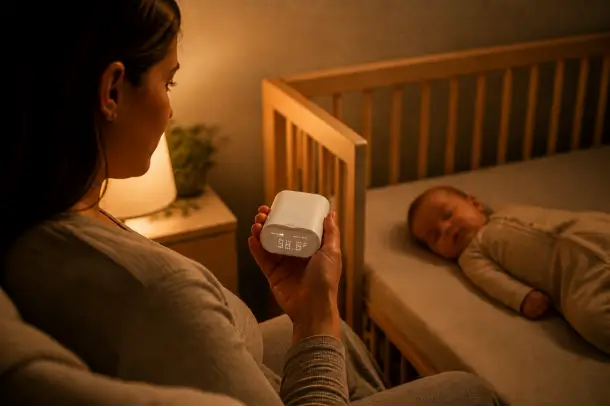
A baby monitor can make ordinary in-home check-ins more convenient. You may want to hear when your baby stirs while you are in another room, glance at the nursery before going to bed yourself, or hand the parent unit to the caregiver taking the next shift.
For families who prefer a dedicated screen without adding another app to the routine, a non-WiFi baby monitor uses a direct connection between the camera and parent unit. That means there is no home internet connection, account, or phone setup to manage before checking the room.

Some routines genuinely involve more than one space. If you are checking two children in separate rooms or need two angles in one room, the VAVA Baby Monitor with Split Screen includes two cameras and shows both live feeds on one parent unit. For a one-room routine, a simpler one-camera setup may be all you need.

The monitor’s role is straightforward: it helps you see or hear the room from elsewhere at home. It does not change the safe sleep setup or replace going to your baby when they need care. The FDA states that no currently available baby product, including a baby monitor, has been shown to prevent or reduce SIDS risk.
Place cameras and power cords according to the manufacturer’s instructions, keeping cords out of the sleep space. That lets the monitor stay useful without becoming part of the crib setup.

What Should You Do When a Baby Sleep Schedule Suddenly Stops Working?
A routine can feel as though it has stopped working overnight. A baby who usually settles easily may take a short nap, wake more often, or resist bedtime after several smooth days. That does not always mean the schedule needs to be rebuilt.
Start with what may have changed around sleep. Your baby may be hungry, uncomfortable, unwell, overstimulated, or simply having a different day. Make sure the sleep space still follows the safe sleep guidance, then look back at the previous 24 hours before changing bedtime or naps.
Short Naps
One short nap is usually just one part of the day. Notice what happens next: does your baby wake contentedly, seem tired again quickly, or have more difficulty settling later on?
If short naps become a pattern over several days, look for the context around them. A busy morning, a missed feed, an unfamiliar setting, or a change in the pre-sleep routine may matter more than the length of one nap. Choose one small adjustment and keep the rest of the day familiar long enough to see whether it helps.
Night Waking
Night waking can still be normal in the first year. Respond to feeding, comfort, and health needs first, then keep the interaction calm and low-stimulation where you can. The American Academy of Pediatrics notes that many babies wake briefly between sleep cycles, and some can return to sleep after a few minutes.
Instead of treating one wake-up as proof that bedtime is wrong, look at the larger pattern. Was the day unusually busy? Was a nap missed? Has your baby been uncomfortable or unwell? A repeated pattern gives you more useful information than one difficult night.
Sudden Changes
Illness, travel, visitors, changes in feeding, and unusually stimulating days can all make a familiar rhythm feel different for a while. When you can, return to the cues your baby already knows rather than adding several new strategies at once.
If the change continues, or it comes with concerns about feeding, growth, pain, breathing, unusual sleepiness, or your baby’s general wellbeing, contact your pediatrician. A sleep schedule should make daily care easier. It should never explain away a health concern.
When Is It Time to Contact Your Pediatrician About Sleep?
Contact your pediatrician for a persistent sleep concern connected with feeding, growth, pain, breathing, unusual sleepiness, or a marked change from your baby's normal pattern. Also call when your instincts tell you something is wrong.
Seek emergency help for trouble breathing, blue or gray color, unresponsiveness, or unusual difficulty waking. These are among the emergency warning signs in the AAP parent guide to urgent care. Use your local emergency number for an acute emergency.
What Should You Remember When Building a Baby Sleep Schedule?
A helpful baby sleep schedule is not one that makes every day look the same. It is one that gives your family a familiar rhythm to return to when naps are short, bedtime shifts, or life gets busy.
Start with the age-based sleep range, pay attention to what repeats over a few ordinary days, and keep the cues that help your baby recognize sleep time. When something changes, adjust one part of the routine and give it time before deciding what to do next.
Keep safe sleep practices the same for every nap and every night. With that foundation in place, the routine can stay flexible enough to support your baby and practical enough for the people caring for them.
FAQs
1. Do Wake Windows Need to Match a Chart Exactly?
No. Time since waking can be one useful clue, but it is not a universal prescription. Use it alongside your baby’s feeding needs, sleep cues, health, and the rest of the day. Do not keep a hungry, unwell, or very tired baby awake to reach a number from a chart.
2. Is There One Right Number of Naps for Every Age?
No. The sleep-duration guidance in this article counts total sleep across 24 hours, including naps. Instead of chasing a fixed nap count, look for a sustained pattern that supports feeding, mood, settling, and nighttime sleep.
3. Should I Wake My Baby to Protect the Schedule?
A schedule should never override feeding or individualized medical guidance. For healthy babies, use a day’s pattern as information rather than a reason to force a routine. If you are unsure about feeding, growth, or a change in sleep, ask your pediatrician for advice tailored to your baby.
4. What If Daycare or Another Caregiver Uses a Different Routine?
Share the short version of your plan: familiar sleep cues, any feeding instructions, the safe sleep setup, and what you want recorded when the day differs. A consistent order is often easier for another caregiver to follow than a minute-by-minute timetable.
5. What Should I Include in a Caregiver Sleep Handoff?
Include the current sleep cues, the last feed and sleep period, anything unusual that day, the safe sleep checklist, and when to contact you or the pediatrician. If you use a dedicated parent unit, pass along the charged screen and show where it usually stays.
Resources
- World Health Organization: Making Sure Newborns and Children Under 5 Years Sleep Safely
- American Academy of Sleep Medicine: Recommended Amount of Sleep for Pediatric Populations
- Dias et al.: Reference Values and Changes in Infant Sleep-Wake Behaviour During the First 12 Months of Life
- American Academy of Pediatrics: Getting Your Baby to Sleep
- NHS: Helping Your Baby to Sleep
- NICHD Safe to Sleep: Ways to Reduce Baby’s Risk
- American Academy of Pediatrics: A Parent’s Guide to Safe Sleep
- FDA: Baby Products with SIDS Prevention Claims
- American Academy of Pediatrics: When to Call Emergency Medical Services for Your Child


Share: