

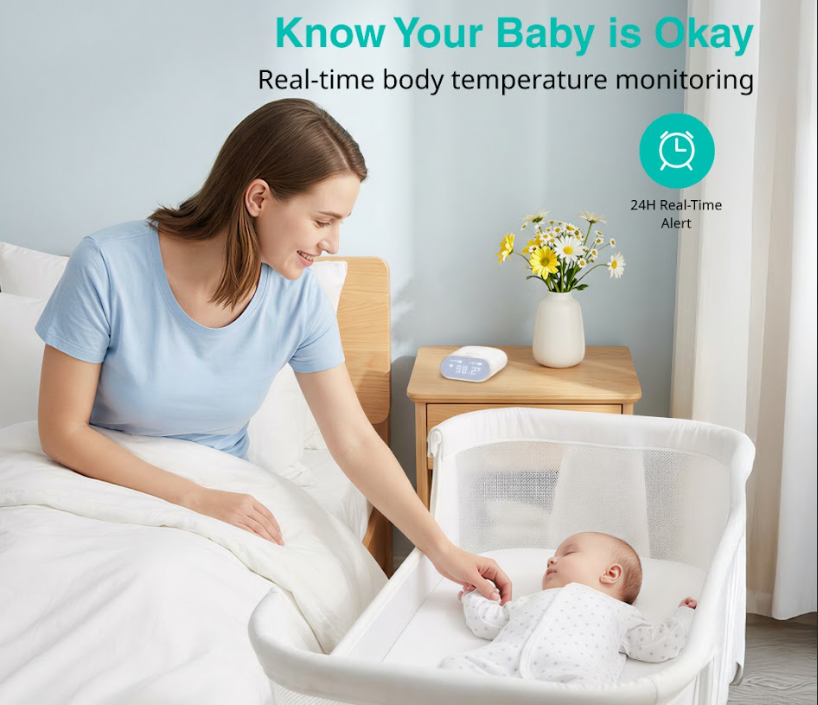
There is no single best baby thermometer for every family. The right choice depends on your baby’s age, the type of reading you need, and how you plan to use the thermometer at home.
A digital rectal thermometer may be preferred when confirmation matters most for a young infant, while forehead, ear, and underarm options can make routine checks easier as your child grows.
Wearable thermometers serve a different purpose, such as repeated real-time monitoring during rest or overnight care.
This guide compares each type by age, accuracy, comfort, and everyday use.

What Is the Best Baby Thermometer for Most Families?
There is no single thermometer that is the best choice for every age and situation. For many families, the most practical setup combines one thermometer for a clearer confirmation reading with another for quick daily checks.
For routine checks, a forehead thermometer can provide a quick reading when you need to check your child once.
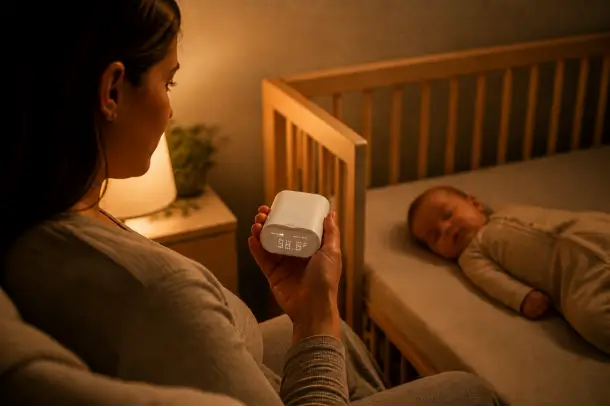
If you expect to measure temperature repeatedly over several hours, a wearable underarm thermometer offers a different experience by monitoring continuously instead of requiring a new manual check each time.
This can make temperature monitoring easier for both caregivers and children, especially during rest or overnight care.
For many homes, the choice comes down to the task:
- Need a confirmation reading: Choose an age-appropriate digital thermometer and follow the instructions carefully.
- Need a quick routine check: Consider a forehead thermometer that is easy to position and read.
- Need repeated checks during rest: Consider a wearable underarm monitor with the functions your family needs.
- Need a backup: Keep a simple digital thermometer available.
Which Baby Thermometer Is Best for Your Baby’s Age?
The best thermometer for your baby depends on age, the type of reading you need, and how much contact your child will tolerate. For younger babies, confirmation is usually the priority. As children grow, quick readings and easier daily use may become more important.
Age-Based Thermometer Guide
|
Baby’s Age |
Best Main Option |
Good Backup Option |
What To Watch Out For |
|
Birth To 3 Months |
Digital Rectal |
Forehead As A First Pass |
Do Not Rely On Ear As Your Main Method |
|
3 To 6 Months |
Rectal Or Forehead |
Underarm As A Quick First Check |
Confirm Odd Readings With Your Pediatrician’s Recommended Method |
|
6 To 12 Months |
Forehead Or Ear |
Wearable Underarm For Tracking |
Placement Still Matters With Ear Thermometers |
|
12 Months And Older |
Forehead Or Ear |
Basic Digital Backup |
Do Not Mix Methods And Expect The Same Number Every Time |

For babies from birth to 3 months, a digital rectal thermometer is still the benchmark. A forehead reading can be useful as a quick first look, but it should not replace a confirmation method when the number seems high or your baby looks unwell. A rectal temperature of 100.4°F (38°C) or higher in a baby under 3 months needs prompt medical guidance.
From 3 to 6 months, many parents start using forehead readings more often because they are faster and less stressful during routine checks. Ear thermometers still are not the best main choice yet because proper placement is harder in a small ear canal.
From 6 to 12 months, forehead and ear thermometers become more practical for everyday use. If sleep-time monitoring is important in your home, this is also when a wearable underarm monitor can become useful for trends and alerts. A product like the VAVA Smart Baby Thermometer fits that role because it is built around continuous underarm monitoring rather than one quick confirmation reading. VAVA’s official product page lists 24-hour battery life, a 1.5-hour charging time, a 15m / 49ft stable connection, FDA-cleared status, and 10 included adhesives.
Once your child is 12 months or older, convenience usually wins most of the time. Forehead and ear thermometers are easier to pack, faster to use, and less disruptive than rectal checks. Still, when a number does not fit the situation, it is smart to confirm it with the more reliable method your care team recommends.
Which Type of Baby Thermometer Is the Most Accurate?
The most accurate choice depends on your baby’s age and the kind of reading you need. For a young infant, a digital rectal thermometer is generally used when a clearer confirmation reading matters most.
Forehead, ear, and standard underarm thermometers are more useful for quick checks, while a wearable underarm thermometer is designed for repeated monitoring over a longer period.
Accuracy And Convenience Comparison
|
Thermometer Type |
Best For |
Main Strength |
Main Limitation |
|
Digital Rectal |
Newborns And Confirmation Reads |
Most Reliable Reading |
Least Convenient |
|
Forehead / Temporal |
Fast Checks, Bedtime, Travel |
Quick And Easy |
More Sensitive To Skin Condition And Technique |
|
Ear |
Babies 6 Months+ |
Fast And Low Fuss |
Placement Matters, Not Ideal Before 6 Months |
|
Underarm |
Quick First Pass |
Easy And Familiar |
Less Reliable For Final Confirmation |
|
Wearable Underarm |
Overnight Monitoring And Trends |
Continuous Tracking And Alerts |
Not The Top First-Line Confirmation Tool |

A standard thermometer is useful when you need one reading quickly. If you expect to check temperature several times over a few hours, a wearable underarm thermometer can monitor continuously instead of requiring a new manual measurement each time. This can make monitoring easier for both caregivers and children during rest or overnight care.
Forehead thermometers are useful for quick checks because they are easy to use and involve little contact. However, sweat, direct sunlight, cold air, and scanning distance can affect the reading, so follow the device instructions carefully.
Ear thermometers can also provide fast readings, but correct positioning matters. The thermometer should be suitable for your child’s age, and the ear canal must be large enough for the probe to fit correctly.
When Should You Use Rectal, Forehead, Ear, or Underarm Readings?
Choose a thermometer based on the job you need it to do. Confirming a concerning temperature, taking one quick reading at bedtime, and monitoring temperature over several hours are different situations.

Middle-of-the-Night Checks
A forehead thermometer can provide a quick reading when your baby is asleep and you want to avoid prolonged contact. It is useful when you need one temperature check with minimal movement or disruption.
A Warm Baby Who Still Seems Fairly Normal
A forehead or underarm thermometer may be useful for a first check when your baby feels warm but is still drinking, responding normally, and behaving as usual. If the reading does not match your child’s condition, repeat the measurement using the same method and follow your healthcare professional’s advice.
A Baby Under 3 Months With Concerning Symptoms
For a baby under 3 months, contact a healthcare professional promptly if you are concerned about a fever or your baby seems unwell. Use the measurement method recommended for your baby and follow the device instructions carefully.
Repeated Monitoring During Rest Or Overnight Care
A standard thermometer is useful when you need one reading. A wearable underarm thermometer is designed for a different situation: it can measure continuously over a longer period, so caregivers do not need to repeat the same manual check every time. This can also reduce the need for a child to repeatedly pause, wake, or cooperate with another measurement.
The VAVA Smart Baby Thermometer fits this use case because its product page lists real-time monitoring, audio and visual fever alarms, 24-hour battery life, and a soft food-grade silicone design.
Which Method Fits This Situation?
- Need one confirmation reading: Use an age-appropriate digital thermometer.
- Need a fast bedtime check: Consider a forehead thermometer.
- Need a quick check for an older child: Consider an ear thermometer if the probe fits correctly.
- Need a simple first check: Consider an underarm thermometer.
- Need repeated monitoring during rest: Consider a wearable underarm thermometer.
How Much Should You Spend on a Baby Thermometer?
Most families do not need to spend a lot to get a useful baby thermometer. As price goes up, you are often paying for speed, ease of use, tracking features, and better nighttime convenience rather than a dramatic jump in core medical reliability.
Budget Tier Breakdown
|
Budget |
What You Usually Get |
Best Fit |
|
Under $20 |
Basic Digital Rectal Or Multi-Use Thermometer |
Newborn Confirmation Or Budget Backup |
|
$20 To $50 |
Better Forehead, Ear, Or Quick-Check Options |
Faster Routine Checks |
|
$50 To $100 |
Premium Ear Or Forehead Models |
Easier Everyday Use, Better Displays |
|
$100+ |
Wearable Monitors With Alerts And Tracking |
Overnight Monitoring And Trend Tracking |
A simple digital thermometer can still handle the most important job well. The higher tiers mostly buy convenience. Above $100, the value shift is usually clear: you are paying for continuous monitoring, alerts, and a better overnight experience, not the most medically trusted first-line confirmation method. VAVA’s official product page currently lists the Smart Baby Thermometer at $119.99 with real-time monitoring, alert features, and a 15m / 49ft connection.
What Features Should You Focus on When Buying a Baby Thermometer?
Focus on the features that make readings easier to take, easier to repeat, and easier to understand. The right features depend on the job you need the thermometer to do. A newborn thermometer may need a different design from a thermometer used for quick checks during sleep or overnight care.
For Accuracy-First Buying
Look for these features first:
- Age-Appropriate Design
- Suitable Tip Or Sensor Design
- Clear Readout
- Simple Cleaning Routine
- Clear Measurement Instructions
For Convenience-First Buying
Look for these features if you want easier daily use:
- Fast Read Time
- Backlit Display For Low-Light Checks
- Silent Mode For Sleeping Children
- Fever Alert
- Comfortable Wearability
A wearable product like the VAVA Smart Baby Thermometer fits the repeated-monitoring use case. Instead of taking a new manual reading each time, it can measure temperature continuously over a longer period and provide alerts. This can make monitoring easier for both caregivers and children during rest or overnight care.
What Common Mistakes Make Baby Thermometer Readings Less Reliable?
Readings can be affected by the wrong method, skipped instructions, poor placement, or comparisons between different measurement sites. A rectal reading and a forehead reading may not show the same number because they measure temperature in different ways.
Common mistakes include using an ear thermometer before it fits correctly, taking a forehead reading on sweaty skin, measuring too soon after coming in from very hot or cold conditions, holding a contactless thermometer at the wrong distance, and treating an underarm reading as a final confirmation.
Contact thermometers should also be cleaned after use, and families should check whether separate devices are recommended for oral and rectal measurements.
Before You Retake a Reading
- Dry The Skin First
- Let The Child Adjust After Coming In From Very Hot Or Cold Conditions
- Use The Same Method And Measurement Site Again
- Check The Device Instructions
- Clean The Sensor Or Tip As Recommended
- Confirm An Unexpected Reading With An Age-Appropriate Method
When Should You Call a Doctor If Your Baby Has a Fever?
Call your pediatrician right away if your baby is 3 months old or younger and has a rectal temperature of 100.4°F (38°C) or higher. That is one of the clearest fever rules in pediatric guidance. Mayo Clinic also says to contact your care team if a baby 3 to 6 months old has a fever and seems unusually irritable, lethargic, or uncomfortable.
Fever Red Flags
- Age 3 Months Or Younger With 100.4°F (38°C) Or Higher
- Trouble Breathing
- Very Hard To Wake Or Not Responding Normally
- Signs Of Dehydration
- Seizure
- A Concerning Rash Or Other Serious Symptoms
If your gut says something is off, trust that signal and call.
Which Baby Thermometer Fits Your Main Use Case?
The best baby thermometer depends on the task you need it to handle. A thermometer for a newborn confirmation reading may be different from one used for quick bedtime checks, budget backup, or repeated monitoring during rest.
Best For Newborn Confirmation
Digital Rectal Thermometer
Why It Fits: A digital rectal thermometer is commonly used when a clearer confirmation reading is needed for a young infant.
Keep In Mind: It is less convenient for quick routine checks.
Best For Quick Forehead Checks
Forehead Or Temporal Thermometer
Why It Fits: It provides a quick reading with little contact, which can be useful when your baby is sleepy or already upset.
Keep In Mind: Sweat, outdoor temperature, and scanning technique can affect the reading.
Best For A Budget Backup
Basic Digital Thermometer
Why It Fits: A basic digital thermometer can cover occasional checks and provide a simple backup at home.
Keep In Mind: Lower-cost models may have fewer convenience features, such as backlit displays or alerts.
Best For Repeated Overnight Monitoring
Wearable Underarm Thermometer
Why It Fits: A wearable underarm thermometer is designed for continuous measurement over a longer period. It can reduce the need for caregivers to take a new manual reading each time and can make monitoring easier for children during rest.
Keep In Mind: Check the model’s instructions, age guidance, alert functions, and wear-time requirements before use.


Best For A Simple Starter Setup
Forehead Thermometer Or Basic Digital Thermometer
Why It Fits: This type of setup can cover many routine checks without adding extra features or a more involved setup.
Keep In Mind: If you expect to measure temperature repeatedly over several hours, a separate wearable monitoring option may fit that need better.
Can One Baby Thermometer Do Everything?
One baby thermometer can handle most routine checks for many families, but it usually will not do every job equally well. If you have a newborn, or if sleep-time monitoring is important in your home, a two-thermometer setup is usually the smarter move. One tool gives you a dependable confirmation method. The other makes daily life easier.
Best 2-Thermometer Setups for Real Life
- Newborn Family: Rectal + Forehead
- Sleep-Focused Family: Rectal + Wearable Monitor
- Budget Family: Basic Digital Thermometer + Upgrade Later
How to Choose the Right Baby Thermometer for Your Family
To choose the best baby thermometer, start with your baby’s age, then your main use case, and only after that think about budget. If you have a newborn, keep a digital rectal thermometer at home. If your baby is older, a forehead or ear thermometer will probably handle most routine checks more easily. If overnight monitoring matters in your house, a wearable baby thermometer option can make fever checks much easier without replacing a proper confirmation method when you need one.
Your next step is simple: pick your confirmation thermometer first, then decide whether you also need a fast-check or monitoring option. If sleep-time tracking is high on your list, compare wearable baby thermometer options next and take a close look at the VAVA Smart Baby Thermometer for overnight use.
FAQs About Choosing a Baby Thermometer
Is a wearable baby thermometer useful for repeated monitoring?
Yes. A wearable thermometer is designed for continuous measurement over a longer period, so caregivers do not need to take a new manual reading every time. It can be useful during rest or overnight care when repeated handling would be inconvenient.
Can room conditions affect a forehead thermometer reading?
Yes. Sweat, direct sunlight, cold air, and scanning distance can affect forehead readings. Let your child adjust after coming in from very hot or cold conditions, keep the skin dry, and follow the device instructions for positioning.
How often should you replace adhesive patches on a wearable thermometer?
Follow the brand’s instructions. VAVA’s product page shows an adhesive refill pack and notes that adhesives are part of the product system, so replacement should follow the brand’s care guidance and actual wear condition.
When should you replace a wearable thermometer adhesive?
Follow the product’s care instructions and replace the adhesive when it no longer keeps the sensor securely and comfortably in place. Check the adhesive condition before each use and use the replacement type recommended for that model.
Should you keep two thermometers at home for one baby?
For many families, yes. One thermometer can handle most routine checks, but a two-thermometer setup is often more practical if you have a newborn or want overnight monitoring, because it gives you one option for confirmation and another for convenience or longer tracking.

Share: