

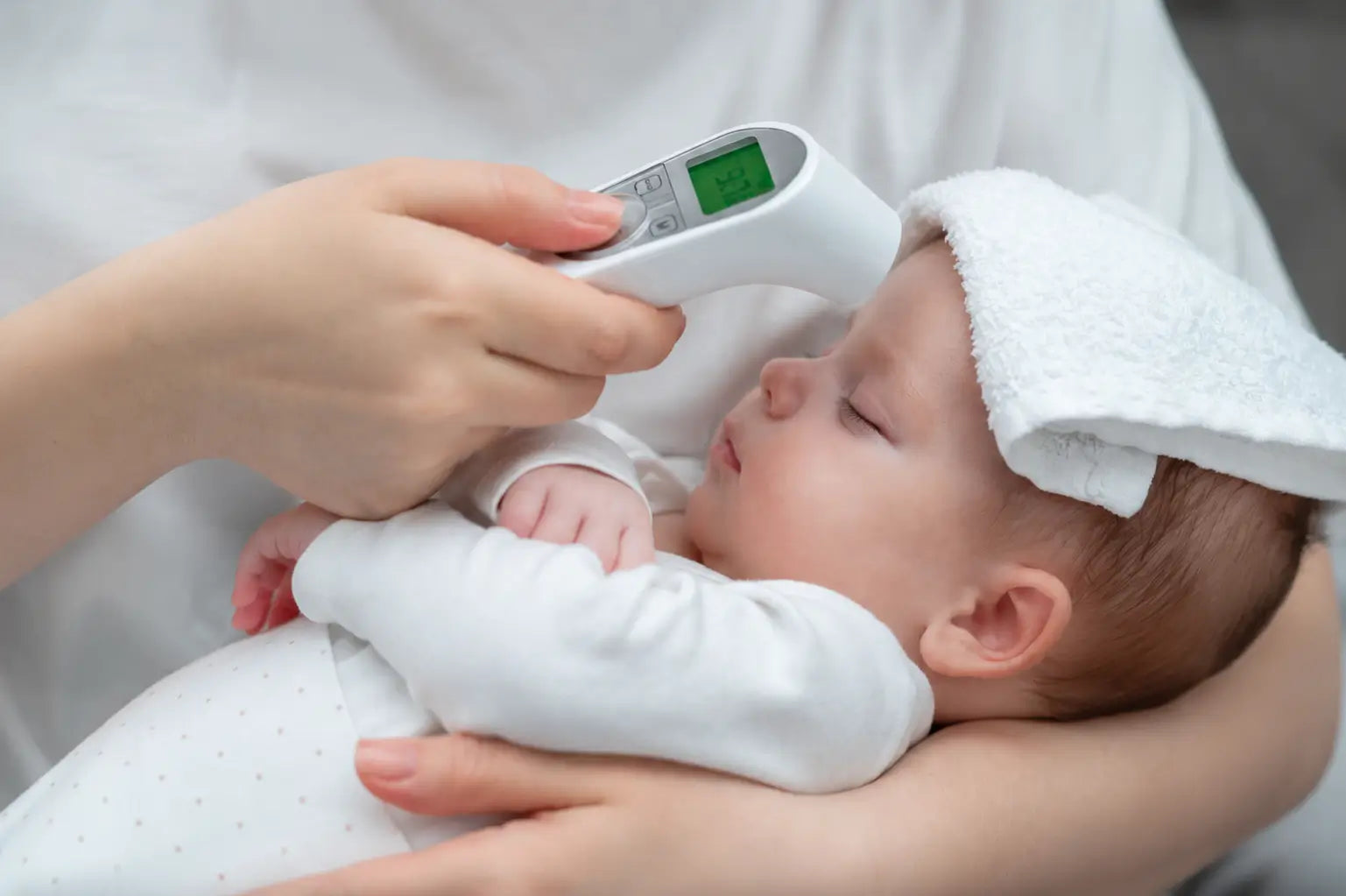
A temporal thermometer measures temperature from the forehead area over the temporal artery. It uses infrared sensing to estimate body temperature quickly, usually in just a few seconds.
For babies, the main benefit is that the reading is fast and low-disturbance, especially when your baby is sleepy, fussy, or already resting.
Forehead readings are convenient, but they are also sensitive to technique, sweat, room conditions, and skin surface temperature. That is why correct placement and a clean, dry forehead matter.
In this guide, we’ll explain how temporal thermometers work, how to use one on a baby, when they are useful, when to confirm a reading, and how they compare with other baby thermometer options.

What Is a Temporal Thermometer?
A temporal thermometer, also called a temporal artery thermometer, is a forehead thermometer that estimates temperature by reading infrared heat from the skin over the temporal artery.
The temporal artery runs across the forehead and temple area. Because blood flow in this area is close to the skin, a thermometer can use the heat pattern there to estimate body temperature. Some models are designed to glide across the forehead. Others are held near or against the forehead for a short scan.
The design depends on how the thermometer collects heat readings. A swipe-style model may scan across more of the temporal artery area, while a hold-style model focuses on a smaller target area for a short moment. That is why it is important to follow the instructions for your specific thermometer instead of using every forehead thermometer the same way.
Parents often choose this type because it is fast and non-invasive. You do not need to place anything under the tongue, into the ear, under the arm, or rectally. That can matter when your baby is tired, crying, or asleep.
Still, a temporal thermometer is not the same as a core body temperature measurement. It reads heat at the skin surface and then uses built-in calculations to estimate body temperature. That makes correct placement and a stable environment important.

How Do You Use a Temporal Thermometer on a Baby?
Use a temporal thermometer by scanning the forehead area exactly the way your model’s instructions describe. The basic idea is simple: start with a clean, dry forehead, place the sensor correctly, scan or hold as directed, and read the result after the device finishes.
Start With a Clean, Dry Forehead
Make sure your baby’s forehead is dry and free of sweat, lotion, hair, hats, blankets, or anything else that covers the skin.
If the thermometer has just been moved from a very hot or cold place, let it adjust to the room first. A sudden temperature change can affect the reading.
Follow the Scan or Swipe Instructions
Place the sensor flat against the center of the forehead, or hold it at the exact distance listed in the instructions.
Press and hold the button, then scan across the forehead toward the hairline or temple if your model is a swipe-style thermometer. If your model is a hold-style thermometer, keep it steady for the short scan time instead.
Release the button only after the scan is complete. Then read the display and note the time, method, and result if you are tracking readings.
Check the Manual Before Using Behind the Ear
Some temporal thermometers include behind-the-ear measurement as part of their instructions, especially when the forehead is sweaty. Do not assume this works for every model.
If your thermometer allows it, follow the manual exactly for where to place the sensor and how long to scan. If the manual does not mention behind-the-ear use, stick with the forehead method.
How Accurate Is a Temporal Thermometer for Babies?
A temporal thermometer can be useful for quick baby temperature checks, but it is more sensitive to technique than some other methods.
Forehead readings can change based on the device, the room, your baby’s skin condition, and how you hold or swipe the thermometer. That is why two readings taken a minute apart may not always match exactly.
Best for Quick Checks
A temporal thermometer works well when you want a fast, low-disturbance reading. It is especially helpful when your baby is sleepy, fussy, or hard to keep still.
For everyday checks, the reading can help you decide whether your baby seems fine or needs a closer look.
Readings Can Be Affected by the Forehead
Sweat, lotion, hair, hats, blankets, direct sunlight, cold outdoor air, or a warm room can all affect a forehead reading.
Before measuring, make sure the forehead is clean, dry, and uncovered. If the number seems odd, pause for a moment and repeat the reading the same way.
Know When to Confirm
A temporal thermometer is helpful, but some situations need a more careful reading. This is especially true for very young babies or when the number does not match how your baby looks.
For babies under 3 months, a temperature near or above 100.4°F (38°C) should be handled according to your pediatrician’s guidance.
When Is a Temporal Thermometer Useful?
A temporal thermometer is most useful when you need a fast, gentle temperature check with minimal disruption.
It can work well when:
- Your baby is sleeping and you do not want to wake them fully.
- Your baby is crying or moving too much for a longer measurement.
- You want to check whether your baby feels warm after a nap.
- You need a quick reading before deciding whether to take another measurement.
- You are checking temperature during a mild illness and want a lower-stress method.
This type of thermometer is also practical at night. When you are half-awake, a quick forehead reading is often easier than trying to use a slower or more invasive method.
But a quick reading only tells you what your baby’s temperature is at that moment. If your baby is running a fever overnight, you may still find yourself getting up again and again to check whether the number has changed.
That is when it helps to compare temporal thermometers with other baby thermometer options, especially wearable thermometers designed for longer temperature checks.
How Does a Temporal Thermometer Compare With Other Baby Thermometers?
A temporal thermometer is usually one of the easiest baby thermometers to use, but it is not the only option. The right choice depends on whether you need a quick check, a longer temperature watch, or a more careful confirmation reading. This is where comparing other baby thermometers can help.
|
Thermometer Type |
Best For |
What to Know |
|
Temporal Thermometer |
Fast, gentle forehead checks |
Works best with a clean, dry forehead and correct scanning technique |
|
Ear Thermometer |
Quick readings in older babies and children |
Best when the probe is positioned correctly in the ear canal |
|
Wearable Thermometer |
Watching current temperature over several hours |
Helpful for overnight monitoring because parents can check readings without repeated manual scans |
|
Rectal Thermometer |
Confirming fever in young infants when recommended |
Often used when a pediatrician wants a more careful confirmation reading |
For many parents, the hard part is not taking one temperature reading. It is trying to keep an eye on a fever through the night without walking back in every hour or waking the baby again.
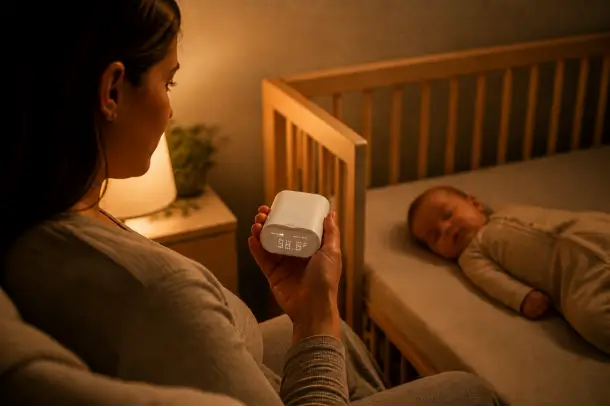
That is where a wearable thermometer can feel more practical than repeated forehead scans. The VAVA Smart Baby Thermometer uses a soft underarm patch and a separate receiver, so parents can check real-time temperature readings from their own room. It also provides audio and visual fever alerts when the temperature reaches the alert threshold, which helps parents notice changes without constantly rechecking by hand.

How Do You Choose a Temporal Thermometer for Your Baby?
Choose a temporal thermometer that is easy to use the same way every time. Consistent technique matters more than a long feature list, especially when you are tired or checking your baby at night.
Helpful features include:
- Fast Reading Time: Many temporal thermometers give a reading in a few seconds, and some models claim results in about 1 to 4 seconds.
- Clear Display and Simple Controls: A backlit display and simple buttons make nighttime checks easier.
- Clear Forehead Instructions: Look for instructions that clearly explain where to place the sensor, whether to swipe, and how long to scan.
- Memory Recall: Recent reading history can help if you want to compare the last few checks.
- Easy Cleaning: A smooth sensor area is easier to wipe between uses.
- Price and Brand Options: Many home temporal thermometers cost about $20 to $60. Exergen and Braun are common examples, but the better choice is the model your family can use correctly and consistently.
Avoid choosing only by the longest feature list. For baby care, reliability and ease of use matter more than extra modes you may not use.
Conclusion
A temporal thermometer is a useful choice when you want a fast, gentle forehead reading for your baby. It works best when the forehead is clean and dry, the sensor is placed correctly, and you use the same method each time.
Be more careful with very young babies, unusual readings, or numbers that do not match how your baby looks. In those moments, confirm the reading with the method your pediatrician recommends.
If you need more than one quick check, a wearable thermometer can make longer temperature monitoring easier. A product like the VAVA Smart Baby Thermometer lets parents follow real-time readings from a separate receiver, which can be helpful during overnight fever checks.

FAQs
1. Should I add a degree to a temporal thermometer reading?
No. Do not automatically add or subtract degrees unless your thermometer’s instructions specifically tell you to.
Use the number shown on the display, and note how you measured it. If you need to call your pediatrician, tell them the exact reading and that it came from a temporal thermometer.
2. Why do I get different forehead readings a few minutes apart?
Small changes can happen if the forehead is sweaty, recently covered, exposed to cold air, or measured in a slightly different spot.
If you need to repeat the reading, use the same method and the same area of the forehead. Do not compare readings from different spots as if they were identical.
3. Is a no-contact forehead thermometer the same as a temporal thermometer?
Not always. Some no-contact forehead thermometers read from the forehead area, but not every one is designed as a temporal artery thermometer.
Check the product instructions. The way you hold, aim, or scan the device depends on the exact model.
4. Is a wearable thermometer the same as a temporal thermometer?
No. A temporal thermometer gives one quick forehead reading. A wearable thermometer stays on the body and helps caregivers follow current temperature readings over a longer period.
This is why a temporal thermometer may work well for quick checks, while a wearable thermometer may fit better for overnight monitoring.
5. How should I clean a temporal thermometer?
Wipe the sensor area according to the product instructions. Many models can be cleaned with a soft cloth or an approved wipe, but you should avoid soaking the device unless the manual says it is safe. Basic baby thermometer maintenance habits also help keep the thermometer ready for the next use.

Share: