

It’s 2 a.m., your child feels warm, and you reach for the thermometer in the dark. The reading comes back borderline high, and now you’re wondering if you should check again with a different method.
Choosing between an infrared thermometer vs. contact thermometer comes down to what you need most: a fast scan, a closer confirmation reading, lower-contact hygiene, or a way to track temperature changes over time.
This guide compares both types by accuracy, ease of use, hygiene, and real-life baby care situations, so you can choose the right thermometer for the moment.

What’s the Difference Between an Infrared Thermometer and a Contact Thermometer?
These two categories measure body heat in fundamentally different ways. Understanding that difference makes the rest of the comparison easier.

Infrared Heat Detection
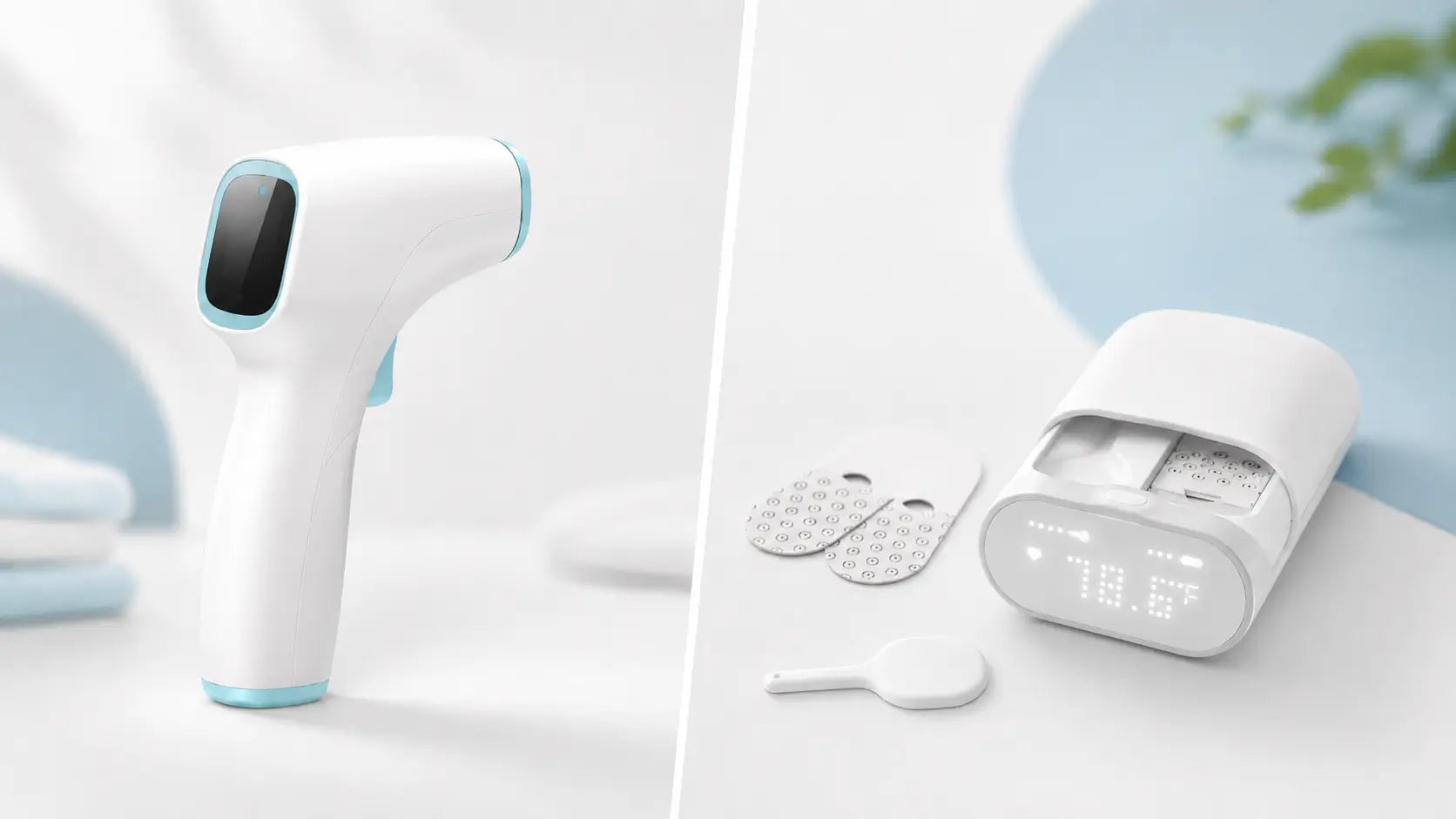
An infrared thermometer reads the heat your body radiates from the skin’s surface. Forehead (temporal artery) models and ear (tympanic) models both fall into this category. You hold or point the device near the skin, and the sensor converts infrared energy into a temperature number, usually in about one to two seconds. There’s little or no direct contact, which makes these thermometers popular for fast checks, especially with squirmy toddlers.
Direct-Contact Measurement
A contact thermometer touches the body to measure temperature directly. Digital oral, rectal, and underarm (axillary) thermometers all work this way. The sensor sits against tissue or skin long enough to register its actual heat. Contact readings tend to reflect core body temperature more closely, which is why they are often the preferred confirmation method.
Traditional Contact Checks vs. Wearable Contact Monitoring
Not all contact thermometers work the same way. A standard digital thermometer is designed for a single spot check. You take a reading, note the number, and put it away. A wearable contact thermometer does something different. A wearable thermometer is a body-worn device that tracks temperature over time instead of giving only one quick reading.
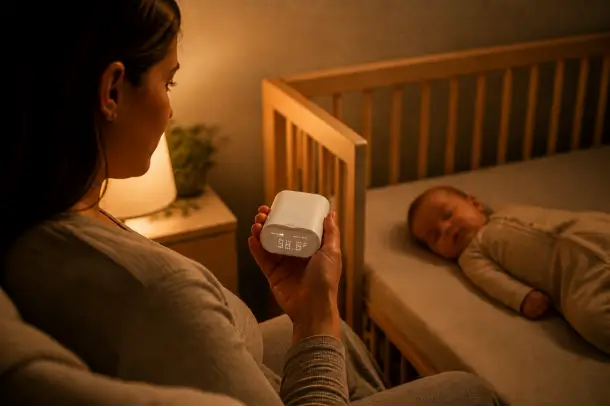
The VAVA smart baby thermometer from VAVA is an example of this format. Simply attach the soft silicone patch to the baby’s armpit, and you can view the temperature on the LCD screen. Instead of waking your child every hour for a new reading, the device stays in place and monitors continuously. It is a completely different approach from a one-time check.
Which Is More Accurate: an Infrared Thermometer or a Contact Thermometer?
Both types can produce reliable readings when used correctly. The difference is in how consistently they perform and in which situations each one is most trustworthy.
Closer Confirmation Readings
Contact thermometers generally produce the most accepted confirmation readings. When you need to decide whether to call a doctor or give medication, a direct-contact reading, especially rectal for infants, tends to be the number healthcare providers trust most.
Infrared Reading Variability
Infrared thermometers can work well for routine fever screening, but their readings are more sensitive to the conditions around your child. Sweat, direct sunlight, cold air, hats, headbands, and the distance between the sensor and the skin can all shift the result.
That does not make infrared thermometers useless. It just means you need to use them carefully. Make sure the forehead is dry, follow the device’s distance instructions, and give your child a few minutes indoors before checking if they just came in from the cold.
Screening and Follow-Up Use
Non-contact infrared thermometers can be used to screen children for fever. However, a secondary check is required using another thermometer when the child’s temperature seems high or doesn’t match how they look. If the reading feels inconsistent or your child’s symptoms are getting worse, switching to a contact method for a follow-up reading makes sense.
Single Readings and Temperature Trends
One number tells you where things stand right now. A series of readings tells you where things are heading, and that trend is often more useful than one isolated check. If your child’s temperature is slowly climbing, that matters even when each reading is still below the fever line.
Traditional thermometers can track trends if you write down each reading. Wearable contact thermometers make this easier because they monitor over time without asking you to restart the process every hour.

Which Is Faster, Easier, and More Hygienic to Use?
Accuracy gets most of the attention, but everyday usability shapes which thermometer you actually reach for at 3 a.m.
Quick-Check Convenience
Infrared thermometers usually give a reading in about 1–2 seconds. You place or point the device near the forehead, follow the distance instructions, and wait for the result. Because the reading time is short, they are useful for quick checks, especially when you need to measure more than one family member.
Cleaning and Shared Use
Infrared thermometers rarely touch skin, so cleaning between users is minimal. Most contact thermometers can be wiped with rubbing alcohol or a damp cloth between uses, making cleaning quick and straightforward for shared family use. Wearable models like the VAVA Smart Baby Thermometer use individual adhesive patches, so the sensor stays with one person and doesn’t cross-contaminate.
Repeated-Check Burden
If you only need one reading, both types are fine. But when someone is sick and you’re checking every hour or two, the experience is very different. A no-touch infrared scan takes seconds and barely disturbs sleep. A standard contact thermometer means waking the child, repositioning, and waiting.
A wearable contact option reduces the repeated-check burden because the sensor stays in place and tracks temperature over time. For example, the VAVA Smart Baby Thermometer provides audio and visual fever alerts when the temperature rises above its alert threshold, so you do not have to wake your baby for every manual check.

What Are the Main Pros and Cons of Infrared and Contact Thermometers?
Here’s a side-by-side summary of the trade-offs covered so far:
|
Infrared Thermometer |
|
|
Pros |
Cons |
|
Fast reading (1–2 seconds) |
More sensitive to environmental factors |
|
No-contact or minimal contact |
May need follow-up with a contact method |
|
Easy to use on sleeping children |
Readings can vary with technique |
|
Simple to share among family members |
Forehead models may be less reliable on newborns |
|
Minimal cleaning required |
Higher purchase cost for quality models |
|
Contact Thermometer |
|
|
Pros |
Cons |
|
Closer to core body temperature |
Slower reading time |
|
Rectal method is the standard for infants |
Requires cooperation or stillness |
|
Wearable options allow continuous tracking |
Standard models need sanitizing between uses |
|
Less affected by room conditions |
Repeated checks can disrupt sleep |
|
Generally lower cost per unit (standard digital) |
Wearable models have a higher upfront cost |
Which Type Is Better for Different Situations?
The right thermometer depends on the moment you’re in. Here are common scenarios and the format that fits each one best.
For Quick Fever Screening
An infrared forehead thermometer works well when you want a fast answer — checking a warm forehead before school, during a playdate, or when everyone in the house is getting the sniffles. If the number looks normal, you can move on.
For Follow-Up Confirmation
When an infrared reading seems high or doesn’t match how your child looks, a contact method gives you a closer answer. For infants under 3 months, that means a rectal reading. For older children, an oral or underarm check can serve as a reliable second step. If you’re unsure about the right method for your child’s age, the guide on how to take a baby’s temperature accurately covers each technique in detail.
For Repeated Checks Over Time
When a fever is active and you want to see whether it is rising, holding, or dropping, a wearable contact thermometer is often the most practical option.
This is where the VAVA Smart Baby Thermometer can fit naturally. It is built for continuous underarm monitoring instead of one quick spot check. Its 24-hour battery life and 15m / 49ft stable connection are useful for overnight monitoring, especially when you want to check temperature changes from another room.
For Shared Household Use
If multiple family members are getting sick at the same time, an infrared thermometer keeps the process fast and hygienic. No probe covers, no sanitizing between each person, just scan, read, and move on.
For Lower-Disruption Monitoring
If your priority is watching a fever overnight without waking a sleeping baby every hour, a wearable contact option handles the job with the least disruption. The device monitors continuously and alerts you when the temperature crosses a set threshold. This means fewer wake-ups, fewer manual checks, and less disruption during the night.
Conclusion
Choosing between an infrared thermometer vs. contact thermometer isn’t about picking a winner. Infrared models are ideal for fast, no-touch screening — especially when you need a quick read across multiple family members. Contact thermometers give you closer confirmation readings and, in wearable formats, the ability to track temperature trends over hours without repeated checks.
The best choice depends on the situation. Many families use different formats for different moments: fast screening when symptoms first appear, confirmation when a reading seems high, and continuous tracking when overnight monitoring becomes tiring.
If tracking fever trends with fewer manual checks matters to you, the VAVA Smart Baby Thermometer is worth a closer look.
Frequently Asked Questions
1. Why can two thermometers give different temperature readings?
Different thermometer types measure different parts of the body, and each site runs at a slightly different baseline. A rectal reading is typically 0.5–1°F higher than oral, while an underarm or forehead reading tends to run 0.5–1°F lower. Each method has a typical offset range, so comparing the same method each time gives you the most consistent picture.
2. How often should I recheck a temperature if someone seems unwell?
There’s no universal schedule, but a common guideline is every 2–4 hours during an active fever. If your child looks comfortable and the fever is mild, less frequent checks may be fine. When the fever is higher or rising, more frequent readings help you spot changes faster. A wearable thermometer can handle this automatically without repeated manual checks.
3. Are wearable contact thermometers only useful for babies?
No. A wearable thermometer is a body-worn device that tracks temperature over time instead of giving only one quick reading. It can help parents, family caregivers, and care teams monitor babies, older adults, or patients who need closer temperature observation. Anyone recovering from surgery, managing a chronic condition, or dealing with a stubborn fever can benefit from continuous monitoring.
4. Why do forehead thermometer readings sometimes seem inconsistent?
HealthyChildren notes that direct sunlight and cold temperatures after being outside can affect forehead readings. Sweat, lotions, and holding the device too far from the skin can also shift the number. For the most reliable forehead check, make sure the skin is dry and your child has been indoors for at least 10–15 minutes.
5. What matters more: one temperature reading or the overall trend?
The trend usually tells you more. A single reading captures one moment, but a pattern of readings, rising, falling, or holding steady, helps you and your pediatrician make better decisions. If choosing the most accurate baby thermometer for trend tracking is your goal, a wearable option designed for continuous monitoring is the most practical fit.

Share: