


A baby night light with white noise can be useful when two things regularly make nighttime care harder: you need enough light to feed or change your baby, and ordinary household sounds keep interrupting a quiet room.
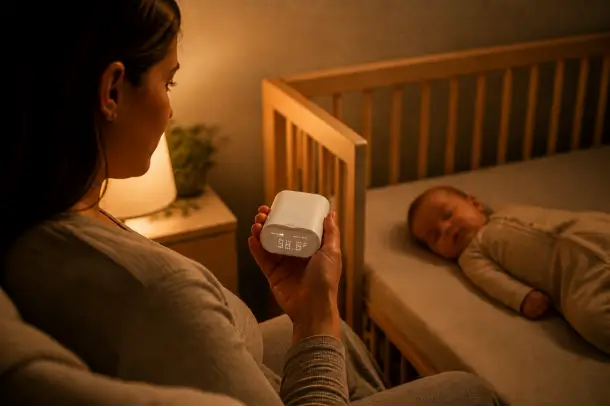
Picture a late-night bottle feed while an older child is still awake, the dishwasher is running, or someone closes a bedroom door down the hall. A dim, reachable light helps you see the bottle, diaper, and wipes without turning on the room light. A steady background sound can help soften those brief changes in household noise. Keeping both functions in one bedside device means less reaching for separate lamps, phones, or apps when your hands are already full.
You do not need a light-and-sound device if a quiet room and a simple night light already meet your needs. It is most useful for families who want both functions close at hand during feeds, diaper changes, settling, or travel. This guide explains how to set up white noise thoughtfully, then choose the light, sound, controls, and portability that fit your routine. If you are also building a broader bedtime rhythm, see our guide to a newborn sleep schedule.

Why Do Parents Choose a Baby Night Light With White Noise?
Parents choose white noise because it gives the room one steady background sound. When footsteps in the hallway, a closing door, or a dishwasher are part of the evening, those sudden sounds do not stand out as sharply.
The American Academy of Pediatrics notes that white noise is sometimes used to drown out environmental noise. It can also become a familiar part of settling down for the night. For a wider look at that part of the routine, see our guide to a newborn sleep schedule.
In a small randomized study of newborns, 16 of 20 babies exposed to white noise fell asleep within five minutes, compared with 5 of 20 in the control group. The study was small and involved babies aged two to seven days, so it cannot predict what will work for every family. It does help explain why many parents consider white noise for more than a noisy hallway.

Which White-Noise Features Matter?
First, check what type of sound the device actually provides. Lullabies, rain tracks, and nature sounds may be pleasant, but they are different from white noise. If you want a steady background sound to soften household noise, confirm that white noise is included.
Then look at the controls that affect everyday use:
- Adjustable volume, so you can keep the sound low.
- A timer, so you can choose when the sound stops.
- More than one sound option, if your family wants to try different steady sounds.
- Controls you can use without reopening a phone app.
The VAVA Egg Baby Night Light Plus includes 18 built-in white-noise sounds and 30-, 60-, and 90-minute timer settings. The number of sounds is useful only if you want options; the more important question is whether the sound can stay at a comfortable level and fit naturally into your routine.
How Can You Set Up White Noise Thoughtfully?
White noise works best as a gentle background layer, not as the loudest sound in the room. Start at a low volume, then raise it only enough to soften the household sound you are trying to cover.
Keep your baby's crib clear, as AAP safe-sleep guidance recommends. Place the white-noise device elsewhere in the room, as far away from your baby's head as possible. That is the specific placement advice from the AAP noise guidance.
Think about duration, too. The AAP also advises using white noise for a short time only. A timer gives you a simple way to decide how long the sound is useful for your evening instead of leaving that decision until you are tired.
The VAVA Egg Baby Night Light Plus has 30-, 60-, and 90-minute timer choices. You might use a shorter setting while settling your baby, then adjust on another night if the household is still active. The aim is not one universal timer. It is a routine you can set deliberately.
Before you leave the room, check three things: the crib is clear, the sound is low, and the timer fits the moment. These small choices let white noise support the routine without taking over the room. For the light side of the setup, you can also review these baby night light dos and don'ts.

Which Light Setting Helps With Care After Dark?
At midnight, you do not need to light the whole room. You need enough light to check a diaper, find a wipe, see a bottle measurement, or settle your baby back into the crib without fumbling in the dark.
The American Academy of Pediatrics advises parents to keep nighttime lights dim and the environment boring during feeds. That makes adjustable brightness more useful than a lamp with one fixed setting. Use the lowest level that still lets you complete the care in front of you, then turn it down again.
Light color gives you another way to shape the moment. A warm light can make a feeding corner feel softer, while a different color may be easier to see beside changing supplies. The useful feature is not a promise that one color suits every baby. It is having a small choice instead of being stuck with one harsh, unchangeable light.
The VAVA Egg Baby Night Light Plus gives you four adjustable light modes, including warm and RGB light, with dimmable brightness and a Night Mode. That means the same light can stay low for a quick overnight check, then become brighter when you need to deal with a fuller diaper change or prepare a feed.

Before choosing the best night light for a nursery, picture the place where you do most nighttime care. Can the light sit within reach? Can you make it dim enough for a quiet feed but bright enough to see what you are doing? Those two answers matter more than a decorative glow.
Which Controls Help When Your Hands Are Full?
A combined light-and-sound device is most useful when its controls match the sequence of nighttime care.
For instance, you may turn on a dim light to change a diaper, then want to switch the light off after your baby is settled while leaving the chosen sound on for a little longer. Or you may want to adjust brightness without changing the sound or timer. These are small actions, but they determine whether the device simplifies the moment or becomes another thing to manage.
Before buying, check whether the model lets you control these functions separately:
- Light brightness
- Sound volume
- Sound selection
- Timer duration
- Light on/off without resetting the sound
Touch controls can also be helpful if the device will sit beside a feeding chair or bed. The right setup is one you can adjust quickly, without needing to put your baby down, unlock your phone, or restart the entire routine.
Which VAVA Option Fits Your Routine?
Start with the one feature that changes the choice: do you want white noise built in? If the answer is yes, the VAVA Egg Baby Night Light Plus is the most direct match. It combines 18 built-in white-noise sounds with four adjustable light modes, dimmable brightness, Night Mode, and 30-, 60-, and 90-minute timer options.
Choose the Egg when you want one bedside device that covers both nighttime care and a steady sound option. Its wider sound selection is useful if you want to try more than one white-noise setting before settling on a regular routine.
The VAVA Peep-a-Light is the more portable alternative. It combines dimmable light with eight soothing sounds, has touch controls, and includes a silicone handle for carrying or hanging. It is a good fit when you expect the light to move between the nursery, a feeding spot, and travel.

If you only need light, the VAVA Baby Night Light keeps the choice simpler. It has no built-in sound feature listed; instead, it focuses on dimmable touch control, eight color options, and a one-hour timer. Choose it when white noise is not part of your routine.
Your routine should make the choice. For a regular bedside setup with white noise, the Egg brings the most sound choice into one device. For a light that moves with you, the Peep-a-Light is easier to carry. For light alone, the Baby Night Light keeps things simple. If your feeding light and sound device normally live in different rooms, a light-only option plus a separate sound solution may also make more sense.
Conclusion
Nighttime care is made up of small, repeated moments: feeding a hungry baby, changing a diaper, finding the wipes, and helping everyone settle again. A good baby night light gives you enough light for those jobs without filling the room with brightness. When household noise is part of the picture, white noise adds a steady background sound that can make the room feel less interrupted.
The useful features are the ones that make this easier in practice. Choose light you can dim, white noise you can adjust, and controls you can use without breaking the flow of care. Set the sound up thoughtfully, with the device away from your baby's head and a timer that suits the moment.
Those are the details you will notice at 2 a.m., when a light-and-sound device is either easy to use or one more thing to manage. Explore VAVA baby night lights when you are ready to find the combination that fits your home.
FAQs
1. Can I Use White Noise for Naps as Well as Bedtime?
Yes, when there is a reason to soften sudden daytime sounds. It can be useful for a nap in a home where older children, pets, or household chores are still going on. Use the same careful setup you would at night: low volume, distance from your baby's head, and a limited duration.
2. What If My Baby Seems Sensitive to One White-Noise Sound?
Try a different steady sound at a low level rather than assuming white noise is not for your baby. Parents often find that the texture of a sound matters, which is why more than one built-in option can be useful. If no setting feels helpful, it is fine to keep the room quiet and use the light on its own for care.
3. Can White Noise Replace the Rest of a Bedtime Routine?
No. White noise is one calming tool, not a replacement for feeding, a fresh diaper, comfort, or responding when your baby needs you. The AAP includes calming sounds among several ways parents can try to soothe a fussy baby.
4. Can I Use the Light Without Playing White Noise?
Yes. On the VAVA Egg Baby Night Light Plus, you can use the light for a feed or diaper change without turning on the sound. This is useful when you need visibility but the room is already quiet.
5. Can I Move a Light-and-Sound Device Between Rooms?
You can if you choose a rechargeable model. When you move it, set it up again with the same care: place it well away from your baby's head, adjust the light and sound for the new room, and use the timer if the sound is only needed for settling.
6. Can the Light and Sound Be Changed Separately?
That depends on the model, so check this before you buy. On the VAVA Egg Baby Night Light Plus, the light can be put into standby without interrupting the audio or timer. This lets you turn the light off after a diaper change while keeping the chosen sound setting in place.
Resources
Share: