


At 2 a.m., even a short walk across the room can feel inconvenient when you are carrying a baby. Diapers that are stored too far away, a drawer that blocks the walkway, or a light that is brighter than expected can make feeding and changing harder than they need to be.
Your baby may not sleep in the nursery right away, but the room can still be useful for changing, feeding, clothing, and daytime care. If care happens in more than one room or on more than one floor, keeping a few essentials close by can also save repeated trips through the house.
A well-planned nursery should fit the way your family actually uses the space. This guide covers what to prepare first, where to place the crib and other furniture, how to organize nighttime supplies, which care tools may be useful, and what to reconsider as your baby grows.

Where Will Your Baby Sleep, and Where Will Nighttime Care Happen?
Before deciding where every piece of furniture belongs, think about where your baby currently sleeps and what usually happens after they wake. The place used for sleep does not have to be the place used for every feed, diaper change, or clothing change.
The American Academy of Pediatrics recommends room sharing for at least the first six months, with the baby sleeping on a separate surface rather than in the adult bed. This may mean using a crib, bassinet, portable crib, or play yard in your bedroom while keeping larger furniture and most supplies in the nursery.
Sleep and care can happen in different rooms
If your baby sleeps in your bedroom, decide which tasks are convenient to handle there. A quick feed may happen beside the bed, while a full clothing change or a diaper refill may be easier in the nursery.
If your baby sleeps in the nursery, decide whether feeding and changing will also happen there. This determines which parts of the room need to be ready for a typical nighttime wake-up.
Follow your nighttime routine through the home
Walk through a typical wake-up in the order it happens. Where do you pick up your baby? Where do you feed them? Where do you change them, and where do you put used bottles, burp cloths, or diapers afterward?
This is especially useful in a small home or a home with more than one floor. It shows which room needs a complete care area and which location only needs a few essentials, instead of automatically buying duplicate furniture for every space.
Once those locations are clear, you can plan the nursery around the care that will actually happen there. Furniture and storage should support that routine rather than force the routine to fit the room.
What Needs to Be Ready Before You Use the Nursery?
A nursery does not need matching furniture or a fully decorated wall before you can use it. It needs to support the care that will happen there without making you search for supplies, move furniture, or clear a path while holding your baby.
What needs to be ready therefore depends on whether the room will be used for sleep, changing, feeding, storage, or a combination of them.
Essentials for the room’s current use
If your baby will sleep or nap in the nursery, prepare a safe baby sleep environment with a firm, flat surface and a fitted sheet. The American Academy of Pediatrics recommends keeping pillows, blankets, toys, crib bumpers, and other loose items outside the baby’s sleep area.
If you plan to change diapers there, choose a stable surface and keep the supplies within reach. The American Academy of Pediatrics advises keeping one hand on your baby when using an elevated changing surface, even if it has a safety strap.
Items that can wait
A dedicated changing table is optional if another stable setup works better in your space. The same applies to a glider, extra shelving, decorative storage baskets, and a second dresser.
A smaller nursery may work better with fewer pieces of furniture and more open floor space. Waiting also gives you time to see whether you actually prefer feeding in the nursery, changing your baby in another room, or keeping backup supplies somewhere else.
Use the room for a few days before filling every empty wall or corner. When the same inconvenience keeps coming up, such as having nowhere to set down a bottle or repeatedly leaving the room for clean clothes, you will know what the space is genuinely missing.
How Should You Place the Crib, Changing Area, and Chair?
Start with the crib because it has the fewest suitable locations. Once it is in a safe position, the changing area and chair can be arranged around the remaining space.
This may leave the crib slightly off-center or change the layout you originally pictured. A practical arrangement matters more than making every wall look symmetrical.
Place the crib first
Look for a wall away from windows, blind cords, drapery cords, shelves, and other objects your baby may eventually reach. The American Academy of Pediatrics recommends keeping cribs away from windows and window-covering cords.
Leave a clear approach to at least one side of the crib. An open drawer, laundry basket, rug edge, or footstool should not be in the path you use when picking up or putting down your baby.
If a dresser or bookcase stands nearby, secure it to the wall. The U.S. Consumer Product Safety Commission recommends anchoring furniture that could tip over.
Arrange the changing area around your reach
The changing area does not have to sit beside the crib. Place it where you can stand comfortably, open its drawers fully, and reach diapers, wipes, and a change of clothes without turning away from your baby.
When using an elevated surface, the American Academy of Pediatrics advises keeping one hand on your baby. A safety strap does not replace close supervision.
Also check what happens after the change. The hamper and diaper bin should be accessible without blocking the walkway or requiring you to step away while your baby is still on the changing surface.
Fit the chair into the remaining route
The chair should be easy to reach from the door and crib, but it does not need to sit directly beside either one. Leave enough room to sit down and stand up while holding your baby.
Check the space with the chair in the position in which it will actually be used. A glider may need extra clearance behind it, while a recliner can block a drawer or doorway when extended.
Finally, walk from the door to the crib, chair, and changing area with one arm held against your body. This quickly reveals tight turns, furniture corners, open drawers, and items on the floor that may be easy to miss when both hands are free.

Where Should You Keep Nighttime Supplies?
Keep frequently used supplies where the care actually happens, not simply where they look neat on a nursery shelf. One main station can hold the full supply, while smaller kits cover other places where you regularly feed or change your baby.
Stock the main care area for the next few changes
At the main changing area, arrange supplies in the order you use them. Keep the open pack of diapers and wipes closest, followed by diaper cream, a clean outfit, burp cloths, and a place for used items.
Avoid filling the easiest-to-reach drawer with full refill packs. It should hold what you are likely to use soon, while unopened supplies can stay in another drawer, closet, or storage area.
Add a smaller kit where care regularly happens
A small basket or portable caddy can be useful beside the sleep space in your bedroom, in the living room, or on another floor. It might contain a few diapers, wipes, a changing mat, one clean outfit, and a burp cloth.
Only create a second kit when you repeatedly need supplies in that location. If feeding and changing almost always happen in the nursery, extra baskets around the house may simply create more items to check and refill.
Keep the portable kit in one consistent place rather than leaving it on the floor, an adult bed, or beside the crib. Anyone sharing nighttime care should be able to find it without searching through drawers or carrying the baby from room to room.
Keep refill stock separate
Choose one location for unopened diapers, wipes, spare sheets, and outgrown or next-size clothing. This makes it easier to see what is running low without crowding the areas used during a diaper change or feed.
When you refill the smaller kits, return each item to the same position. A simple arrangement that both caregivers understand is more useful at night than several containers organized by appearance.
Which Nighttime Tools Solve a Real Problem?
Nighttime tools are most useful when each one removes a repeated inconvenience. Think about what usually makes care difficult, then choose the feature that addresses it.
|
Nighttime problem |
Tool that may help |
What to check |
|
You cannot see a diaper tab, bottle mark, or the floor clearly |
Dimmable night light |
Low brightness, reachable controls, stable placement |
|
Doors, footsteps, siblings, or household activity interrupt a quiet room |
White noise |
Adjustable volume, steady sound options, timer |
|
Your baby sleeps outside your sight or hearing |
Baby monitor |
Clear night view and audio, usable range, safe camera placement |
|
The nursery feels warmer or cooler at different times |
Room-temperature display |
Easy-to-read changes from the place where the sensor is located |
Light for feeds and diaper changes
A nursery night light should show enough detail for the care in front of you without requiring the overhead light. Place it near the chair or changing area, where you can reach the controls while holding your baby.
Dimmable brightness matters because a quick check and a full diaper change may require different amounts of light. For a closer comparison of brightness, controls and placement, see VAVA’s guide to choosing the best night light for a nursery.
White noise for a steadier sound environment
White noise can make footsteps, closing doors, pets, and other brief household sounds less noticeable. It may also become a familiar part of settling down, so families can still find it useful when the home is already quiet.
A small randomized study of newborns found that more babies exposed to white noise fell asleep within five minutes than babies in the control group. Results will differ from one baby to another, but the study helps explain why parents may use white noise for both background noise and settling.
Keep the sound low and position the device away from your baby’s head. The American Academy of Pediatrics also recommends limiting how long infant white noise is used.
If you want light and sound in the same place, the VAVA Egg Baby Night Light Plus combines adjustable warm and RGB light with 18 built-in white-noise sounds. It also has 30-, 60-, and 90-minute timers, so the sound duration can be set before you begin feeding or settling your baby.

Monitoring from another room
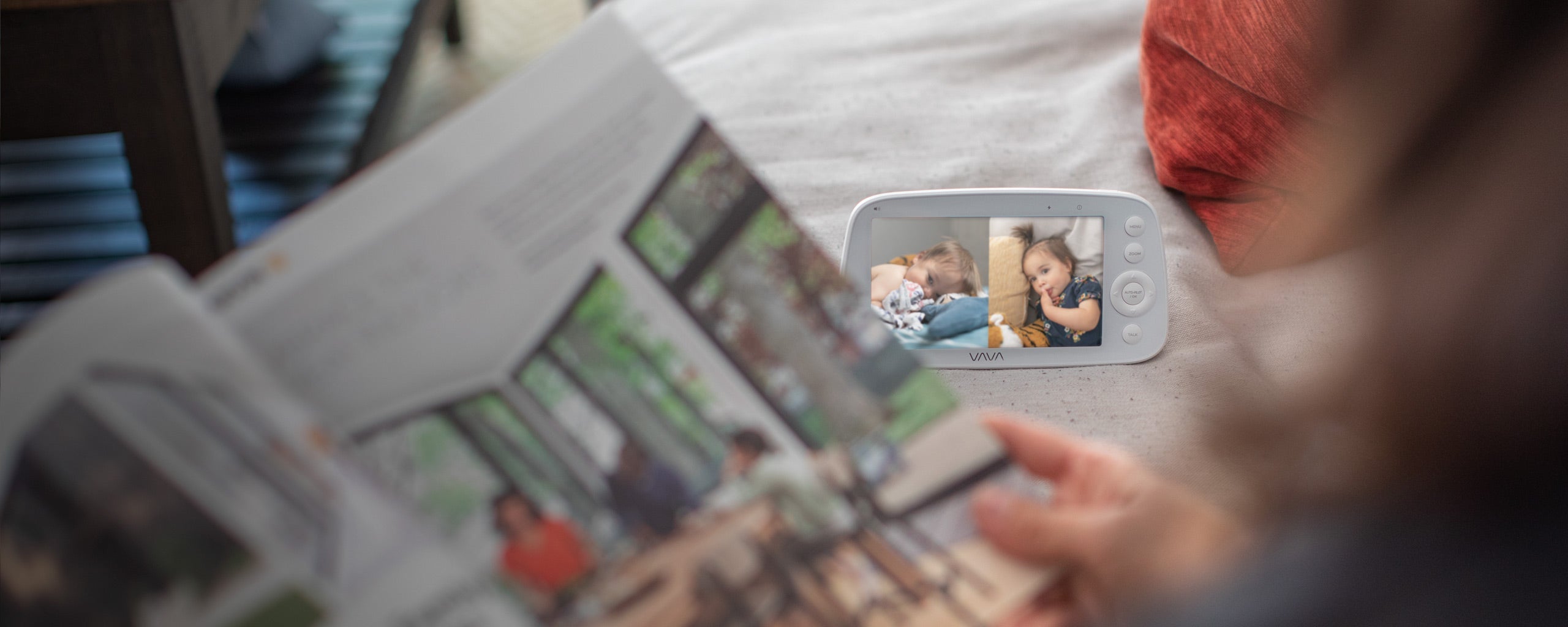
A baby monitor becomes useful when you want to see or hear your baby from another part of the home. Night vision can reduce unnecessary trips into the nursery, while a dedicated parent unit avoids having to unlock a phone and open an app for every check.
Place the camera only after the crib position has been fixed. The U.S. Consumer Product Safety Commission says monitor cords and parts should remain at least 3 feet from every part of the crib, bassinet, or play yard.
Use this baby monitor features checklist as you test the video, audio, and connection from the bedroom, kitchen, living room, or other places where the monitor will actually be used. Advertised open-area range does not show how walls, floors, and the layout of your home will affect the signal.

The VAVA 720P Video Baby Monitor uses a dedicated 5-inch parent unit and includes night vision, two-way audio, temperature alerts, and a camera-base night light with three brightness levels. These combined features may reduce the number of separate devices needed around the crib.
Checking changes in room temperature
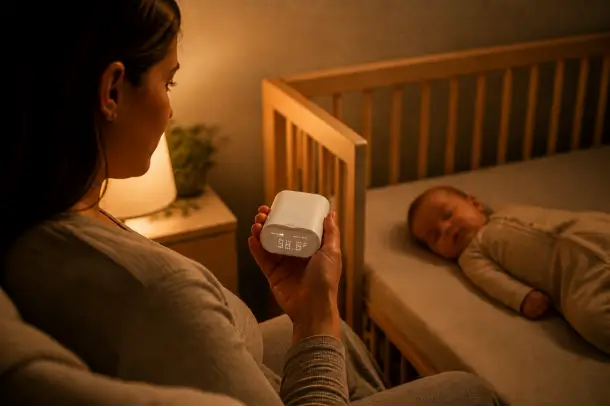
A room-temperature display can help you notice that the nursery becomes warmer after the heat turns on or cooler near a window overnight. Readings are most useful when the sensor stays in a consistent location.
The number represents the air around the device, not your baby’s body temperature. If a monitor includes temperature alerts, set and use them as a room-comfort reference rather than treating the monitor as a medical thermometer.
How Should the Nursery Change as Your Baby Grows?
A nursery layout that works now will not stay suitable forever. Recheck it when your baby’s sleep location changes, when they learn a new way to move, or when your family begins using the room differently.
These changes matter more than waiting for a particular birthday. A baby who can sit, pull up, crawl, or reach through the crib has access to parts of the room that were irrelevant a few months earlier.
Moving sleep into the nursery
When transitioning your baby into their own room, reconsider the room as a nighttime space rather than only a changing and storage area. Check the crib position, the route from your bedroom, the nighttime light, and which supplies need to move with your baby.
This is also when a baby monitor may become more useful. Test its picture, sound, and connection from the places where you spend time after your baby goes to sleep, then adjust the camera without moving the crib toward it.
If the camera moves, secure the full cable again and make sure no part of it has entered the crib area or your baby’s reach.
Sitting and pulling to stand
Follow the crib manufacturer’s instructions for lowering the mattress as your baby becomes able to sit or stand. The American Academy of Pediatrics advises lowering the mattress before a baby can sit independently and moving it to its lowest position before the baby can stand.
Look again at everything beside and above the crib. A mobile, shelf, curtain, cable, or object on a nearby dresser may become reachable once your baby can sit up or pull to stand.
Crawling and exploring the room
Once your baby can move around the floor, check the nursery from their height. Charging cables, night-light cords, diaper creams, plastic packaging, small objects, and lower drawers may now be within reach.
Check that wall anchors and attachment hardware are still secure, especially if a dresser or bookcase has been moved.
Portable caddies may also need a new location. A basket that was convenient beside the changing area can become easy for a crawling baby to empty or pull over.
Changes in the care routine
The room may also need adjustment even when your baby has not reached a new physical milestone. You may stop using the feeding chair, move diaper changes to another room, add a second camera, or need different clothing and supplies within reach.
After any larger change, follow one normal feed, diaper change, or bedtime routine through the room. Finding a blocked drawer, missing supply, poor camera view, or awkward walkway during this check gives you time to correct it before the same problem catches you off guard during a nighttime wake-up.
Conclusion
Start with the parts of the nursery your family will use every day. Decide where your baby will sleep, keep frequently used supplies near the place where care happens, and leave enough room to move comfortably during feeds and diaper changes.
Take another look at the room when your baby moves into the nursery or becomes able to sit, crawl, and stand. Small changes to the crib, storage, cords, and monitoring setup can help the space continue to work as your baby grows.
For nighttime feeds and diaper changes, the VAVA Egg Baby Night Light Plus keeps dimmable light and white noise together, so you can manage both without reaching for a separate lamp or opening audio on your phone. When your baby sleeps in the nursery, the VAVA 720P Video Baby Monitor gives you a dedicated screen with night vision, audio, and temperature alerts for check-ins from another room.
Choose the support that matches the way your nursery is used, then explore the full range of VAVA baby monitors and VAVA baby night lights.

FAQs
1. Can a nursery also be used as a home office or guest room?
Yes, particularly while your baby still sleeps in your bedroom. Decide which function has priority and avoid filling the room with furniture for all three uses at once.
Before the room becomes a regular sleep space, secure computer and charging cables, remove equipment that could be pulled down, and make sure the crib has not become temporary storage. A folding guest bed or compact desk may be easier to remove later than a full furniture set.
2. Does a nursery need blackout curtains?
Not every nursery needs them. Blackout curtains can be useful when daylight or outdoor lighting makes naps and early bedtimes more difficult, but ordinary blinds or shades may already provide enough control.
If you add a window covering, choose a cordless design and keep the crib away from the window. Check the room at the times your baby normally sleeps before deciding whether a darker covering is necessary.
3. Can a baby share a nursery with an older sibling?
Yes, but each child needs a separate sleep space that is appropriate for their age. An infant should not share a bed, crib, or other sleep surface with an older sibling.
Consider whether different bedtimes, nighttime feeds, or early waking will repeatedly disturb either child. Also check that toys, blankets, cords, and furniture used by the older child cannot enter the baby’s crib or become reachable from it.
4. Should the nursery door be open or closed at night?
The U.S. Fire Administration advises closing bedroom doors before going to sleep. A closed door can slow the movement of smoke, heat, and flames during a fire.
Make sure a working smoke alarm can be heard from the nursery and the caregiver’s bedroom. A baby monitor can help with ordinary check-ins, but it does not replace smoke or carbon-monoxide alarms.
5. Where should smoke and carbon-monoxide alarms go near a nursery?
The National Fire Protection Association recommends smoke alarms inside every bedroom, outside each sleeping area, and on every level of the home. Carbon-monoxide alarms should be installed outside sleeping areas and on every level.
Follow the alarm manufacturer’s placement instructions, especially around windows, doors, vents, kitchens, and fuel-burning equipment. Test the alarms regularly rather than waiting for a low-battery warning.
6. Can I use a secondhand crib in the nursery?
Check its manufacture date, model information, hardware, instructions, and recall history before using it. Cribs manufactured or sold in the United States from June 28, 2011 onward must meet the stronger federal crib standards that took effect on that date.
Do not use a crib with missing hardware, improvised replacement parts, damaged components, or a drop-side design. If its identity or compliance cannot be confirmed, choose a sleep product whose current safety status can be verified.
Resources
- American Academy of Pediatrics: How to Keep Your Sleeping Baby Safe
- American Academy of Pediatrics: Make Baby’s Room Safe
- American Academy of Pediatrics: How Noise Affects Children
- NICHD Safe to Sleep: Safe Sleep Environment
- U.S. Consumer Product Safety Commission: Safe and Sound Zone
- U.S. Consumer Product Safety Commission: Anchor It!
- U.S. Consumer Product Safety Commission: Crib Safety
- U.S. Consumer Product Safety Commission: Window Covering Safety
- U.S. Fire Administration: Close the Bedroom Door Before Sleep
- National Fire Protection Association: Smoke Alarm Installation Guide
- White noise and sleep induction
Share: