

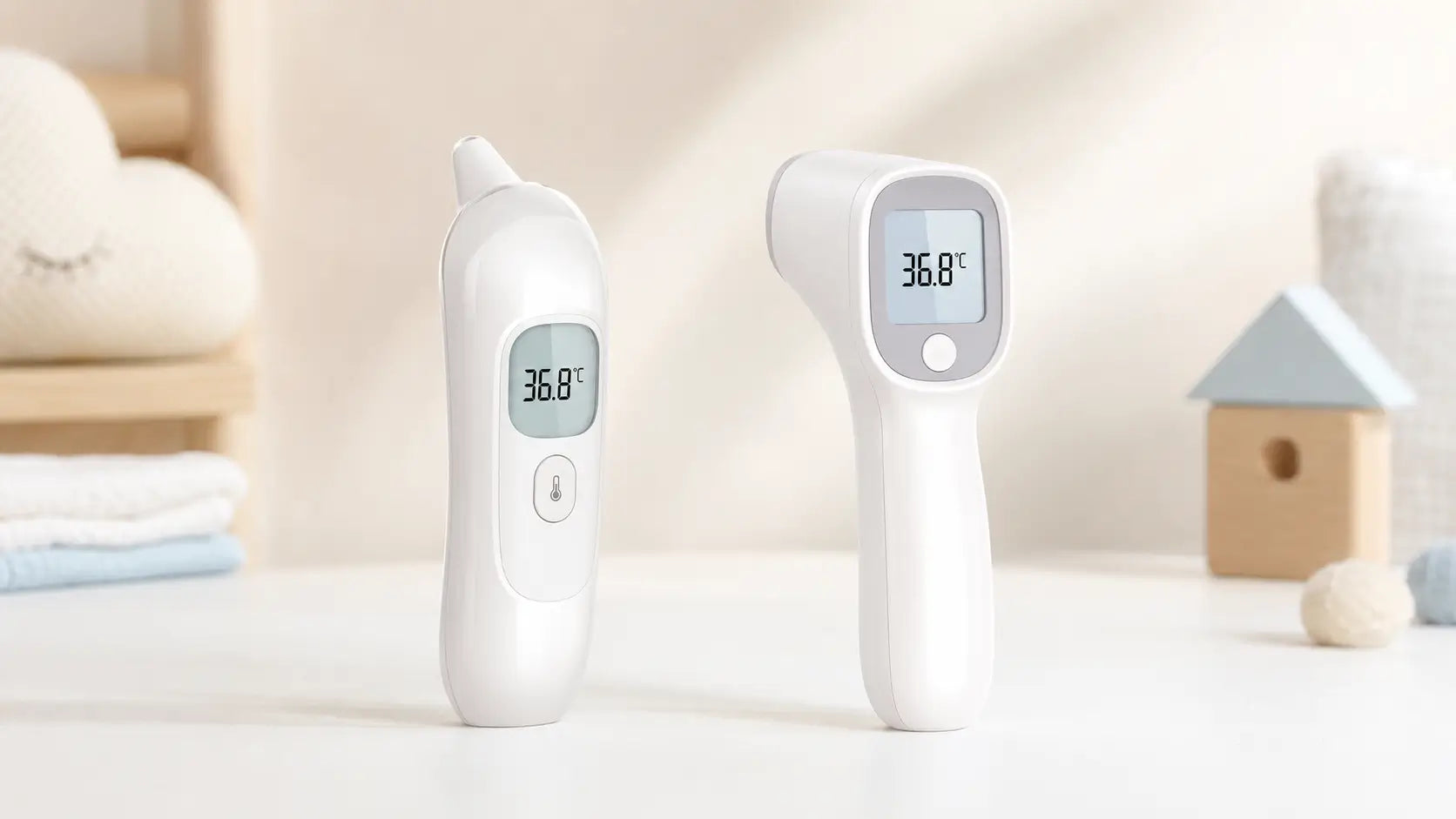
When your baby feels warm, you want a reading you can trust without making an already fussy moment harder. Ear thermometers can be more accurate for babies over 6 months when the probe is placed correctly. Forehead thermometers are usually easier for fast, gentle checks, especially when your baby is sleeping, crying, or hard to keep still.
The better choice depends on your baby’s age, how easily you can position the thermometer, and whether you need one reading or several checks over time. This guide compares ear and forehead thermometers by accuracy, comfort, age limits, common reading errors, and repeated temperature checks.

Which Is Better for Your Baby, Ear or Forehead?
For most babies, a forehead thermometer is easier for quick checks, while an ear thermometer may be more accurate once your baby is over 6 months old and the probe can be positioned correctly. Neither method is best for every baby or every situation.
Here is a quick way to compare them:
|
What You Need |
Forehead Thermometer |
Ear Thermometer |
|
Quick Check |
Usually easier, especially for a sleeping or upset baby |
Fast, but your baby needs to stay still for correct placement |
|
Accuracy |
Useful for screening, but sweat, sunlight, drafts, and scanning distance can affect the result |
Can be more accurate for older babies when aimed correctly at the eardrum |
|
Age Fit |
Often easier for younger babies because nothing goes into the ear |
Not recommended for babies under 6 months |
|
Comfort |
Non-invasive and often no-touch |
Requires placing the probe in the ear canal |
|
Repeat Checks |
Easy for one quick scan, but each reading still requires a new scan |
Each reading requires correct probe placement again |
If your baby is under 6 months, ask your pediatrician which temperature method to use. If your baby is older, the choice usually comes down to whether you need the easiest quick check or the most careful reading you can take correctly.
How Do Ear and Forehead Thermometers Work?
Ear and forehead thermometers both use infrared sensors, but they measure heat from different body sites. That is why the numbers may not match exactly.
A forehead thermometer, also called a temporal artery thermometer, reads heat from the skin over the forehead. Some models touch the skin, while others scan from a short distance. For a deeper look at forehead-style checks, this guide to a temporal thermometer for babies covers how the method works.
An ear thermometer, also called a tympanic thermometer, reads infrared heat near the eardrum after the probe is placed in the ear canal. When the probe is aimed correctly, an ear reading can be useful for older babies and children.
Because each method measures a different site, avoid switching between forehead, ear, underarm, oral, or rectal readings when you are comparing changes. Use the same method each time whenever possible. If you want a broader breakdown of sensor types, this guide to infrared thermometer vs contact thermometer explains the main difference.
Which Is More Accurate for Babies?
Ear thermometers are usually more accurate for babies over 6 months when you can position the probe correctly. For younger babies, a forehead thermometer is often easier to use, but it works better as a quick screening tool than a perfect core temperature reading.
Accuracy comes down to three things: your baby’s age, the body site being measured, and how consistently you can use the thermometer the same way each time.
Ear Thermometers for Older Babies
An ear thermometer measures heat near the eardrum, which can reflect core body temperature more closely when the probe is placed well. That is why ear thermometers can be a strong option for older babies and children who can stay still for the check.
Age is the important limit. The American Academy of Pediatrics notes that ear thermometers are not reliable for babies under 6 months because their ear canals are still too small for good probe placement.
Forehead Thermometers for Quick Checks
A forehead thermometer does not need to go into your baby’s ear, so it is often easier for quick checks on younger, sleeping, or upset babies. Many models also work without direct contact, which can feel more comfortable during a fussy moment.
The tradeoff is that forehead readings depend more on the surface of the skin and the room around your baby. Sweat, cold air, direct sunlight, or the wrong scanning distance can make the number less dependable.
Where a Wearable Thermometer Fits
Ear and forehead thermometers both work best when you can set up each reading correctly. That can be harder when your baby is sleeping, crying, sweating, or too young for an ear thermometer.
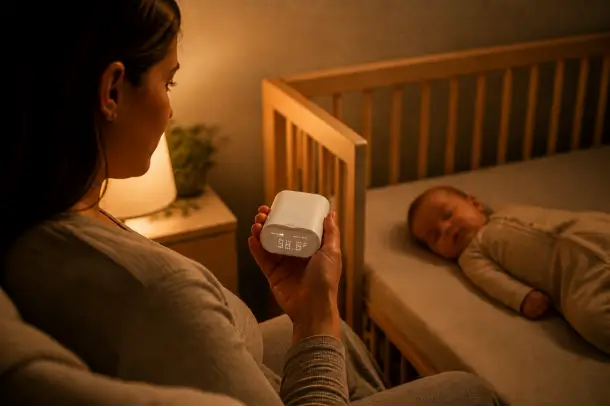
A wearable thermometer takes a different approach. A soft underarm patch, like the one used by the VAVA Smart Baby Thermometer, lets parents check the current temperature on a receiver instead of setting up a new forehead scan or ear reading each time.

When Is a Forehead Thermometer Easier to Use?
A forehead thermometer is usually easier when you need a fast temperature check and your baby will not stay still for long. It can be helpful during a night wake-up, a crying spell, or any moment when you want to avoid moving your baby too much.
Many parents like forehead thermometers because the check only takes a few seconds. No-touch models can also feel easier to use when more than one person at home needs a quick temperature check.
The main limit is that each reading still depends on the right setup. Your baby’s forehead should be dry, the scanner needs the right distance, and the room should not be too drafty or too warm. If you need to check again later, you have to set up the scan again.
When Is an Ear Thermometer a Better Fit?
An ear thermometer is a better fit when your baby is over 6 months old and can stay still long enough for careful probe placement. It can be useful when you want a fast reading that may reflect core temperature more closely than a forehead scan.
The challenge is that ear readings depend heavily on placement. If the probe points at the ear canal wall instead of the eardrum, the reading can be off. Earwax, ear discomfort, or a probe cover that does not fit well can also affect the result.
For babies under 6 months, ear thermometers are usually not the best choice because the ear canal is still too small for reliable placement. Even with older babies, each new reading means you need to position the probe carefully again.
What Can Affect Ear and Forehead Thermometer Readings?
Ear and forehead thermometer readings can change when the device is not used under the right conditions. That does not always mean the thermometer is broken. It often means the body site, room setting, or device position changed.
For forehead thermometers, check these points first:
- Sweat or Moisture: A damp forehead can affect the reading.
- Room Conditions: Cold air, a drafty room, or a very warm room can change the skin temperature.
- Recent Sun or Outdoor Exposure: Direct sunlight, outdoor cold, or a sudden temperature change can affect the forehead surface.
- Scanning Distance: No-touch models need the right distance from the skin.
For ear thermometers, check these points first:
- Probe Angle: The probe needs to aim toward the eardrum, not the ear canal wall.
- Earwax: Wax can block the sensor and affect the result.
- Ear Discomfort: Ear pain or a possible ear infection can make ear readings harder to trust.
- Probe Cover Fit: A loose or poorly fitted cover can affect placement.
For the clearest comparison, use the same thermometer type and the same body site each time. If a reading looks much higher or lower than expected, repeat it with the same method and also look at your baby’s behavior, breathing, feeding, and comfort. You can also read a thermometer correctly by paying attention to timing, placement, and the type of thermometer you use.
When One Temperature Check Is Not Enough
Ear and forehead thermometers work well for spot checks. The harder part starts when you want to keep checking your baby’s temperature through the evening, overnight, or during a fever.
With a forehead thermometer, each new reading means checking the forehead, distance, and room conditions again. With an ear thermometer, each new reading means placing the probe carefully again, which can be difficult if your baby is sleeping, crying, or moving around.
A wearable thermometer helps with this repeated-check problem. The VAVA Smart Baby Thermometer uses a soft underarm patch and a separate LCD receiver, so parents can check real-time body temperature without setting up another forehead scan or ear reading each time.
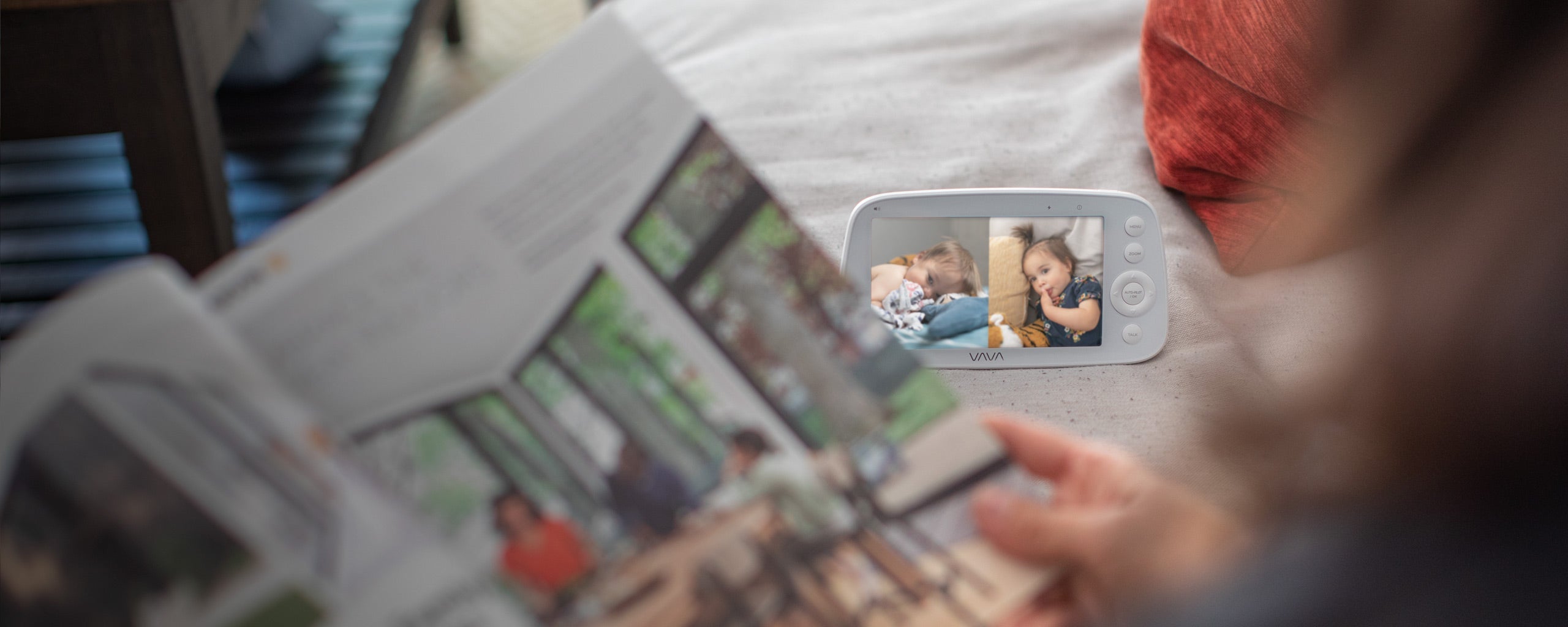
The receiver also provides audio and visual fever alerts when the temperature reaches the alert threshold, so parents do not have to keep walking back in just to take another manual reading.

Conclusion
Ear thermometers are usually more accurate for babies over 6 months when they are placed correctly. Forehead thermometers are usually easier for quick, gentle checks, especially when your baby is sleeping, crying, or hard to keep still.
For one-time checks, either option can work well when you follow the instructions and use the same method each time. For repeated checks, a wearable thermometer can be more practical because you can follow the current temperature without setting up a new forehead scan or ear reading every time.
The VAVA Smart Baby Thermometer fits that role with a soft underarm patch, real-time readings on a receiver, and audio and visual fever alerts for home temperature checks.

FAQs
1. Can I Use an Ear Thermometer on a Newborn?
Ear thermometers are not recommended for newborns because their ear canals are too small for reliable probe placement. For a newborn, ask your pediatrician which temperature method to use, especially if fever is a concern.
2. Why Do Forehead Thermometer Readings Change So Much?
Forehead readings can change because the sensor measures heat near the skin surface. Sweat, cold air, direct sunlight, hair, and scanning distance can all affect the result. Use the thermometer in a stable room setting and follow the device instructions each time.
3. Should I Compare Ear and Forehead Readings Directly?
It is better not to compare ear and forehead readings as if they should match exactly. Different body sites can give different numbers. To understand changes, use the same thermometer type and the same body site each time.
4. What Should I Do if My Baby’s Temperature Reading Seems High?
Repeat the reading with the same method, then check how your baby looks and acts. For babies under 3 months, unusual sleepiness, breathing trouble, poor feeding, or any symptoms that worry you, contact your pediatrician or follow local medical guidance.
5. Is a Wearable Thermometer Helpful for Repeated Baby Temperature Checks?
Yes. A wearable thermometer can help when you want to keep checking your baby’s current temperature without repeating a forehead scan or ear reading each time. The VAVA Smart Baby Thermometer uses a soft underarm patch and a receiver, so parents can check the current reading more easily during home care.

Share: