


An instant-read thermometer works well when you want to check your baby's temperature at a particular moment. A continuous wearable thermometer is more useful when you expect to check again and again, especially during a long nap, an evening at home, or overnight.
The difference is simple. One gives you a reading when you stop and measure. The other keeps the temperature visible after the sensor is in place, so you can follow changes without repeating the whole measurement each time.
This guide compares the two formats in everyday use, explains what to check before buying, and shows how continuous monitoring can make a fever night easier to manage.

When Is an Instant-Read Thermometer the Better Fit?
An instant-read thermometer suits daytime checks, a temperature check before you call the pediatrician, or a quick measurement when your baby feels warmer than usual. It is easy to keep in a drawer or care basket and use only when you need it.
What a Quick Check Actually Involves
A quick reading still requires a few steps. You need to find the thermometer, position it correctly, keep your baby still, and wait for the result. That may be straightforward during the day. It can feel less simple when your baby has just settled, you are holding them alone, or you want to check again later without waking them.
The exact steps depend on the thermometer. A forehead model, an ear thermometer, and a digital contact thermometer do not all work in the same way. Follow the instructions for the model and measurement site you choose.
The Method Matters at Different Ages
Age affects which method is appropriate. The American Academy of Pediatrics notes that ear thermometers are not reliable for babies younger than 6 months because their ear canals are still small. If you are comparing ear and forehead thermometers, check the recommended age and method before choosing one for a newborn or young infant.
This is separate from the speed printed on the box. A thermometer can produce a number quickly, but the reading is only useful when the method fits your baby's age and you use it correctly.
Make the Reading Useful Later
Write down the temperature, the time, and how you measured it. If you speak with your pediatrician, those details help them understand whether the number came from the ear, forehead, armpit, or another method and how it fits with your baby's age, symptoms, and recent temperature changes.
When One Reading Is Not the Real Need
One measurement may answer your question in the afternoon. If you check again an hour later, once before bed, and again during the night, the need has changed. You are no longer looking for one number. You are trying to see how the temperature is moving over time.
A wearable thermometer removes the repeated measurement step. Once the sensor is in place, you can look at the current reading whenever you need it. For repeated checks, that quick glance is the fastest check of all.
When Can a Continuous Wearable Thermometer Be Useful?
A continuous wearable thermometer is useful when you want to follow the temperature over several hours without repeatedly stopping to take another measurement. It can support a long nap, an evening of rest, or overnight monitoring when you want the current reading close by.
Keep the Temperature Visible Over Time
A single reading tells you what the temperature was at one moment. Continuous monitoring adds context. You can see whether the reading is staying steady, rising, or coming back down, and you do not have to rely on memory when several checks begin to blur together.
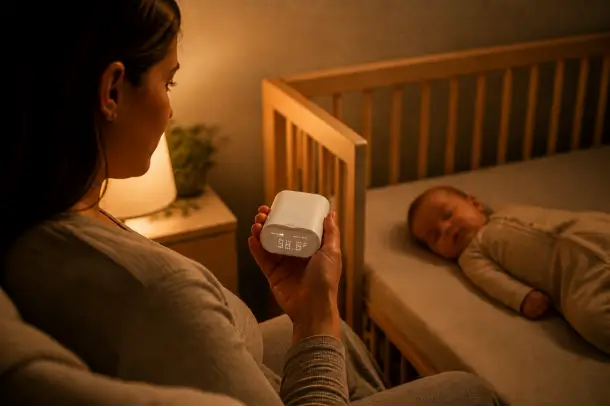
That is especially helpful when a baby has finally settled. Instead of touching the forehead, repositioning a handheld thermometer, or waking the baby for every routine check, you can first look at the display and decide whether anything else needs your attention.

A VAVA Setup for Continuous Checks
The VAVA Smart Baby Thermometer uses a soft silicone sensor worn at the armpit and sends the reading to a dedicated display unit. VAVA lists up to 24 hours of continuous monitoring, audio and visual fever alerts, and measurement precision of +/-0.2 degrees F for this model.
Because the temperature appears on the dedicated display, you do not need to open a phone app each time you want to check. You can keep the unit on a nearby table while you feed the baby, prepare a bottle, finish household tasks, or rest. One look tells you the current reading, and the alert is there if the temperature crosses the product's set threshold.

When It Makes More Sense Than Repeated Checks
A continuous wearable format may fit your routine when:
- you expect to check the temperature several times over the next few hours;
- your baby is resting and you want to avoid repeating the measuring process for every routine look;
- another caregiver needs to see the same current reading on one household device;
- you want an alert to draw your attention when the temperature rises above the set level; or you want a clearer temperature timeline to describe when speaking with your pediatrician.
For more background on how this format works at home, see the guide to wearable thermometers.
What Does Daily Use Look Like With Each Format?
The better fit becomes clearer when you compare what happens after the first reading.
|
What you need |
Instant-read |
Continuous wearable |
|
Check once |
Take one measurement when needed. |
Look at the display after the sensor is in place. |
|
Check again later |
Repeat the measuring steps. |
Glance at the current reading without starting over. |
|
Follow changes during a nap or overnight |
Record separate readings and times. |
Keep the current temperature visible and use alerts for changes. |
|
Best fit |
Occasional, one-time checks. |
Repeated checks and temperature changes over several hours. |
Neither format needs to cover every situation. Some families keep an instant-read thermometer for occasional checks and use a wearable thermometer when they expect a longer period of monitoring. The useful question is not which format has more features. It is how often you will want to see the temperature after the first check.

What Should You Check Before Choosing a Baby Thermometer?
Choose around the way you expect to use the thermometer at home. These five questions will narrow the decision faster than comparing long feature lists.
1. Do You Need One Check or a View Over Time?
If you usually check once and move on, an instant-read model may be enough. If you already know that you will check again before bed, during a nap, or through the night, continuous monitoring can save repeated measurement time.
2. How Old Is Your Baby?
Check the manufacturer's age range and the method recommended for your child's age. The AAP's guidance on how to take a child's temperature is especially useful when you are choosing a method for a newborn or a baby younger than 6 months. You can also review which thermometer type is best for newborns before buying.
3. Where Do You Want to See the Reading?
Some wearable thermometers send readings to a phone. The VAVA model uses a dedicated display unit, so the current temperature stays visible on a household device that can sit beside the crib, on a nightstand, or near the caregiver. Think about which setup you will actually look at when your hands are full or your phone is elsewhere.

4. Which Alerts Would Help You?
Check whether the model provides sound, light, app notifications, or a combination. An alert should make an important change easier to notice. Confirm how the threshold works and whether the controls make sense before the first fever night.
5. What Does the Exact Model Include?
Read the current product page and instructions for placement, operating time, cleaning, age range, display, alerts, and included accessories. Do not assume that every product described as wearable works the same way or includes the same receiver.
If you are still comparing formats, this guide on how to choose the best baby thermometer can help you turn those details into a shorter buying list.
What Should You Do When a Temperature Reading Concerns You?
Check how your baby is behaving as well as the number. Call the doctor right away if a baby 2 months or younger has a rectal temperature of 100.4 degrees F (38 degrees C) or higher. When you call, have the temperature, time, measurement method, symptoms, feeding, and recent changes ready.

Look at Your Baby, Not Just the Number
Notice whether your baby is waking normally, feeding, breathing comfortably, and responding to you. Also look for changes such as unusual sleepiness, difficulty breathing, poor feeding, fewer wet diapers, a new rash, or behavior that feels very different from normal. A thermometer adds information, but it does not replace what you can see and hear.
Know the Number That Always Means Call
The American Academy of Pediatrics advises calling immediately when a baby 2 months or younger has a rectal temperature of 100.4 degrees F (38 degrees C) or higher. For an older baby, use the guidance your pediatrician has given you and call sooner if the baby looks very ill or you are worried.
Be Ready to Tell the Whole Story
Note when the temperature changed, the highest reading you saw, how you measured it, and what else was happening. Tell the pediatrician about feeding, wet diapers, breathing, alertness, medicines, and other symptoms. These details help them judge how urgent the situation may be and what you should do next.
Continuous monitoring can make the timeline easier to describe because you are not trying to reconstruct several separate checks from memory. It can show when the temperature began to rise and whether it stayed elevated, while your observations explain how the baby was feeling and behaving.
What Should You Remember When Choosing a Baby Thermometer?
Choose an instant-read thermometer for occasional checks at a particular moment. Choose a continuous wearable thermometer when you expect to look repeatedly and want the temperature to remain visible while your baby rests.
If repeated checks are the part you want to simplify, the VAVA Smart Baby Thermometer combines an underarm sensor with a dedicated display and high-temperature alerts. It gives you a practical way to keep the current reading nearby without turning every glance into a new measurement.
FAQs
1. Can a Baby Sleep With a Wearable Thermometer On?
Use a wearable thermometer only as the manufacturer instructs and only for the stated age range. Confirm the correct sensor position and patch fit before sleep, and check the skin when you remove it. The crib should still have a firm, flat mattress with a fitted sheet and no loose accessories.
2. Does a Continuous Thermometer Need Wi-Fi or a Phone App?
It depends on the model. Some wearable thermometers use an app, but the VAVA Smart Baby Thermometer shows the reading on its dedicated LCD display. According to VAVA, it works without an app, Bluetooth, or a smartphone.
3. Will the Patch Irritate My Baby's Skin?
Skin can react differently to adhesives. Apply the patch to clean, dry skin exactly as directed, avoid broken or irritated areas, and check the skin after use. Stop using it and contact your pediatrician if you notice a reaction that concerns you.
4. Can I Use an Ear Thermometer on a Newborn?
The AAP says ear thermometers are not reliable for babies younger than 6 months because their ear canals are still small. Check the best thermometer types for newborns and ask your pediatrician which method to use for your baby's age.
5. How Often Should I Check My Baby's Temperature?
There is no single schedule for every baby. Follow the plan your pediatrician gives you and check sooner when symptoms or behavior change. If you are repeatedly measuring just to see whether the number has moved, a continuous wearable thermometer can keep the current temperature visible between the times you assess your baby directly.

Share: